News · Sleep
Short, irregular and broken sleep were each linked to more osteoporosis in 63,083 UK adults
A UK Biobank analysis from China Medical University measured sleep with wrist sensors and followed people for nearly eight years. Poor sleepers were 16% to 23% more likely to be diagnosed with osteoporosis. Earlier studies disagree.
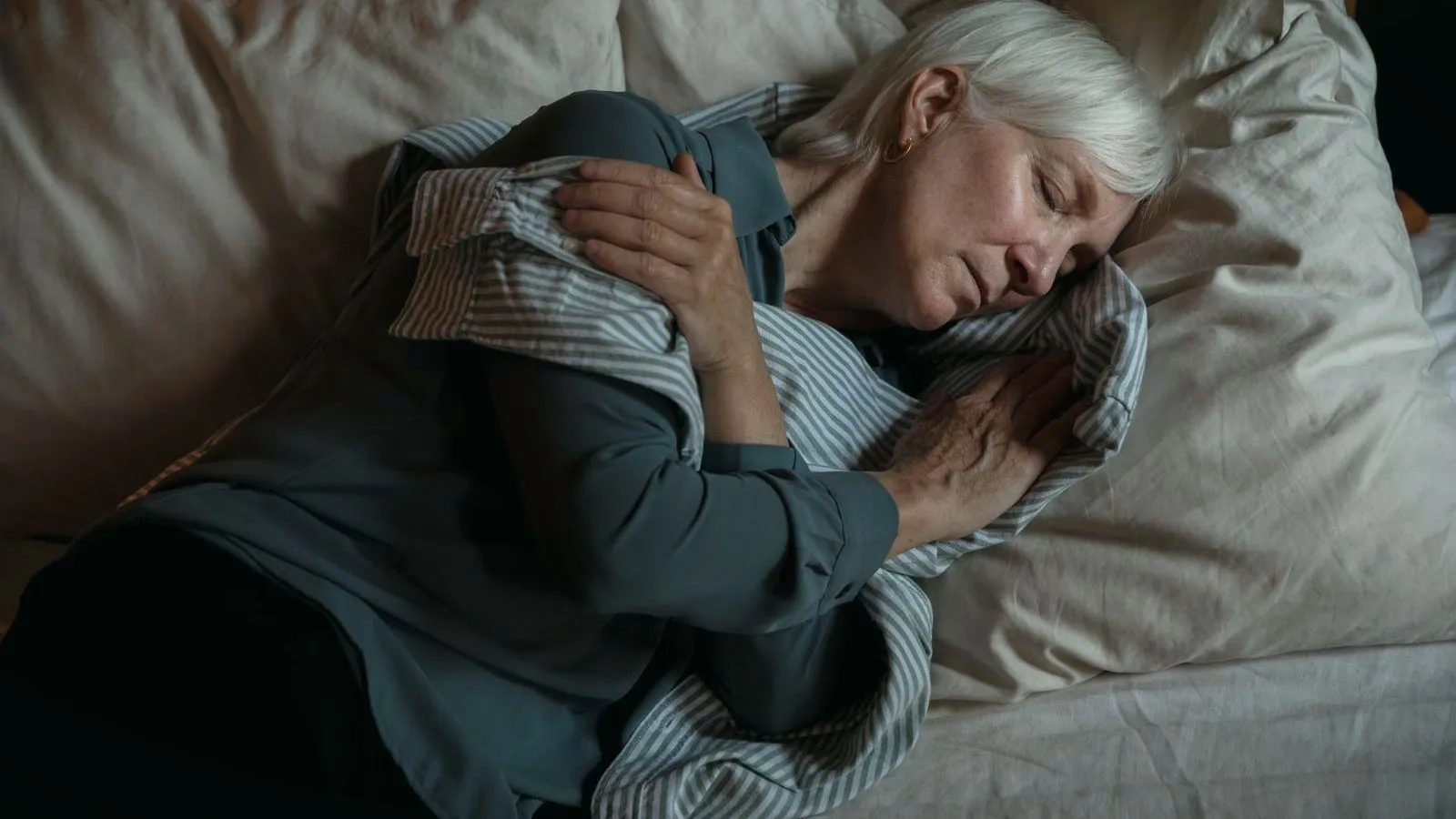
- 63,083 UK adults wore a wrist sensor to record their sleep, and 1,349 later developed osteoporosis.
- Short sleepers had 16% higher risk, irregular sleepers 21%, and those with broken sleep 23%.
- People with poor sleep and high genetic risk had the highest rates of all.
- Earlier studies relied on people describing their own sleep and disagreed about short versus long sleep.
- Sleep was recorded once, poor sleepers differ in other ways, and no trial has tested sleep as a bone treatment.
Bone advice usually comes as a short list: enough calcium and vitamin D, weight-bearing exercise, no smoking. Sleep is not usually on it. Bone is living tissue that is broken down and rebuilt around the clock, though, and a small body of research has been asking whether the nights matter for the skeleton as they do for the heart and the brain.
A large new study gives a cautious yes. Zihao Zheng, Yingliang Wei and colleagues at China Medical University in Shenyang used the UK Biobank to follow 63,083 adults whose sleep had been recorded by a sensor worn on the wrist. Their paper, published in Preventive Medicine at the end of September, reports that people who slept too little, at irregular times or in broken stretches were more often diagnosed with osteoporosis, the condition in which bones become thin and fragile enough to break easily. Earlier work on sleep and bone had mostly depended on people’s own accounts of how they sleep.
How was sleep measured in the osteoporosis study?
The UK Biobank is a long-running health project that recruited half a million British adults. A subset agreed to wear an activity tracker, and the new analysis used UK Biobank accelerometer data collected in the United Kingdom during 2013-2015. From the pattern of movement and stillness, researchers can estimate when each person fell asleep and woke, without relying on memory.
That gave the team three measures per person, which the paper describes as objectively measured sleep duration, regularity, efficiency. Duration is hours asleep. Regularity is how closely sleep and wake times match from one day to the next. Efficiency is the share of time in bed spent actually asleep, so low efficiency means a night with long wakeful gaps.
The researchers then waited. Among 63,083 individuals, 1349 osteoporosis cases occurred during a median 7.8-year follow-up, which is about one new diagnosis for every 47 people.
Which sleep patterns went with more osteoporosis?
All three. After allowing for other differences between people, short sleepers were 16% more likely to be diagnosed than those with normal sleep, irregular sleepers 21% more likely, and people with low sleep efficiency 23% more likely.
Those are modest increases. If the typical participant’s chance of a diagnosis over the period was a little over 2 in 100, a 20% rise brings it to about 2.5 in 100.
The team also asked whether sleep mattered more for people already at risk. Osteoporosis runs in families, and for each participant they built a polygenic risk score, meaning a tally of the many small inherited differences known to affect bone. People who had both a high genetic score and poor sleep had higher osteoporosis risk than those with low genetic susceptibility and normal sleep duration, or regular sleep, or efficient sleep. The gaps ranged from about 57% to 86%. In the authors’ summary, the sleep associations held including when combined with high genetic susceptibility. The comparison stacks two risks against none, so it does not show that sleep is worse for people with risky genes, only that the two add up.
A possible route from poor sleep to weaker bone
Nobody knows for certain. A paper from Christine Swanson’s group, then at Oregon Health & Science University, opens with the plain statement that sleep abnormalities are associated with low bone mineral density and underlying mechanisms are unknown. Bone mineral density is the standard scan measure of how solid a bone is.
That paper describes one of the few experiments on the question. The researchers kept ten men in a laboratory for about three weeks on a schedule built to disrupt them: five and a half hours of sleep in every 24, on a day stretched to 28 hours so that the body clock could never settle. Before and after, they measured blood markers of bone turnover. The marker of new bone being laid down dropped by roughly a fifth to a quarter. The marker of old bone being removed did not change. The authors concluded that the regime can lead to an uncoupling of bone turnover wherein bone formation is decreased but bone resorption is unchanged. Resorption is the removal of old bone. A skeleton that keeps dissolving at the usual rate while rebuilding more slowly will lose ground.
Ten volunteers over three weeks is thin evidence, and markers in blood are a long way from fractures. But it gives the association a possible mechanism. In a later review, Swanson and colleagues wrote that “both sleep timing and duration may be important for optimal bone health as well”, which is the idea the new cohort tested at scale.
What earlier studies of sleep and osteoporosis found
The earlier human evidence points the same way in places and conflicts in others.
The best-known study drew on the Women’s Health Initiative. Heather Ochs-Balcom of the University at Buffalo and colleagues examined a sample of 11,084 postmenopausal women from the Women’s Health Initiative who had bone scans. Compared with women sleeping seven hours, women who reported sleeping 5 hours or less per night had slightly lower bone density at every site measured and were more likely to meet the definition of osteoporosis at the hip and spine. That study measured sleep and bone at the same moment, which cannot show which came first, and its authors asked for follow-up work, writing that longitudinal studies are needed to confirm what they saw. Longitudinal means following people over time.
A meta-analysis two years ago muddied the picture. Junwei Tian and colleagues at Jilin University pooled what had been published. In all, 14 studies were included, and only three of them had followed people over time. They found that long sleep was associated with osteoporosis and short sleep was not, the reverse of the Women’s Health Initiative result, and noted that the definition of short and long sleep varied among studies. Their closing line was a warning: given the low-quality evidence, results must be interpreted with caution.
The new study improves on that literature in the two ways its critics asked for. Sleep was recorded by a device, and diagnoses came later. It also widens the question beyond hours, since regularity and efficiency showed associations at least as large as duration.
Sleep was recorded once, and osteoporosis was a diagnosis
The sensor captured sleep once, in the middle of the last decade, and the diagnoses accumulated over the following years. Sleep habits change, and a single recording cannot show whether someone had slept badly for decades or was having a rough patch.
People who sleep poorly may also differ from good sleepers in ways that bear on bone, such as pain, physical activity, alcohol and medicines that affect both sleep and the skeleton. The analysis adjusted for other factors, and adjustment never removes such differences entirely. Reverse causation is possible as well: the aches of thinning bones, or the illnesses that thin them, can themselves disturb sleep.
UK Biobank volunteers are not a cross-section of Britain, and those who agreed to wear a tracker were a further selected group. The outcome reported is a diagnosis of osteoporosis, which depends partly on who gets tested, and not broken bones.
What the finding does not offer is a target. The categories describe patterns in sensor data, and no trial has shown that lengthening or steadying sleep slows bone loss. Whether a person’s bones need checking or treating depends on their age, sex and history, which their doctor assesses.
In this cohort poor sleep was a marker of slightly higher osteoporosis risk, not a proven cause of it.
People also ask
How much higher was osteoporosis risk with poor sleep?
After adjustment, the hazard ratio for osteoporosis was 1.16 for short sleep duration (95% CI 1.04 to 1.31), 1.21 for irregular sleep (1.02 to 1.43) and 1.23 for low sleep efficiency (1.08 to 1.41). A hazard ratio above 1 means a higher rate, so 1.16 is 16% higher.
What is sleep efficiency?
The share of time in bed that is actually spent asleep. Low efficiency means long periods awake during the night, often called broken or fragmented sleep.
Did genetic risk change the picture?
People with high genetic susceptibility who also slept poorly had the highest risk. Compared with people at low genetic risk who slept well, hazard ratios were 1.58 for short sleep (95% CI 1.23 to 2.03), 1.86 for irregular sleep (1.25 to 2.76) and 1.57 for low sleep efficiency (1.16 to 2.13).
Have other studies linked sleep to bone health?
Yes, with mixed results. A Women's Health Initiative study of 11,084 postmenopausal women found those sleeping 5 hours or less had higher odds of osteoporosis at the hip (odds ratio 1.63, 95% CI 1.15 to 2.31). A 2024 meta-analysis of 14 studies found long sleep, but not short sleep, associated with osteoporosis.
Will sleeping better strengthen bones?
That has not been tested. The study is observational and measured sleep at one point in time, and no trial has examined whether improving sleep changes bone density or fractures. This is general information rather than medical advice.
References
- Zheng, Z., Yang, J., Wang, Y., et al. Associations of sleep duration, regularity, efficiency, and genetic susceptibility with incident osteoporosis: A prospective UK biobank study. Preventive Medicine, 2026.
- Tian, J., Zhang, J., Ding, L., Qi, X. Association Between Sleep Duration and Low Bone Mineral Density and Osteoporosis: A Systematic Review and Meta-analysis. Calcified Tissue International, 2024.
- Ochs-Balcom, H. M., Hovey, K. M., Andrews, C., et al. Short Sleep Is Associated With Low Bone Mineral Density and Osteoporosis in the Women's Health Initiative. Journal of Bone and Mineral Research, 2019.
- Swanson, C. M., Shea, S. A., Wolfe, P., et al. Bone Turnover Markers After Sleep Restriction and Circadian Disruption: A Mechanism for Sleep-Related Bone Loss in Humans. Journal of Clinical Endocrinology & Metabolism, 2017.
- Swanson, C. M., Kohrt, W. M., Buxton, O. M., et al. The importance of the circadian system & sleep for bone health. Metabolism, 2018.