Explainer · Fitness & Exercise
Yoga for chronic low back pain: what 21 trials show and how it compares with other exercise
A Cochrane review of 21 trials found yoga gave small improvements in back function and pain compared with no exercise, and results much like other back exercise. The American College of Physicians lists it among first options for chronic low back pain.
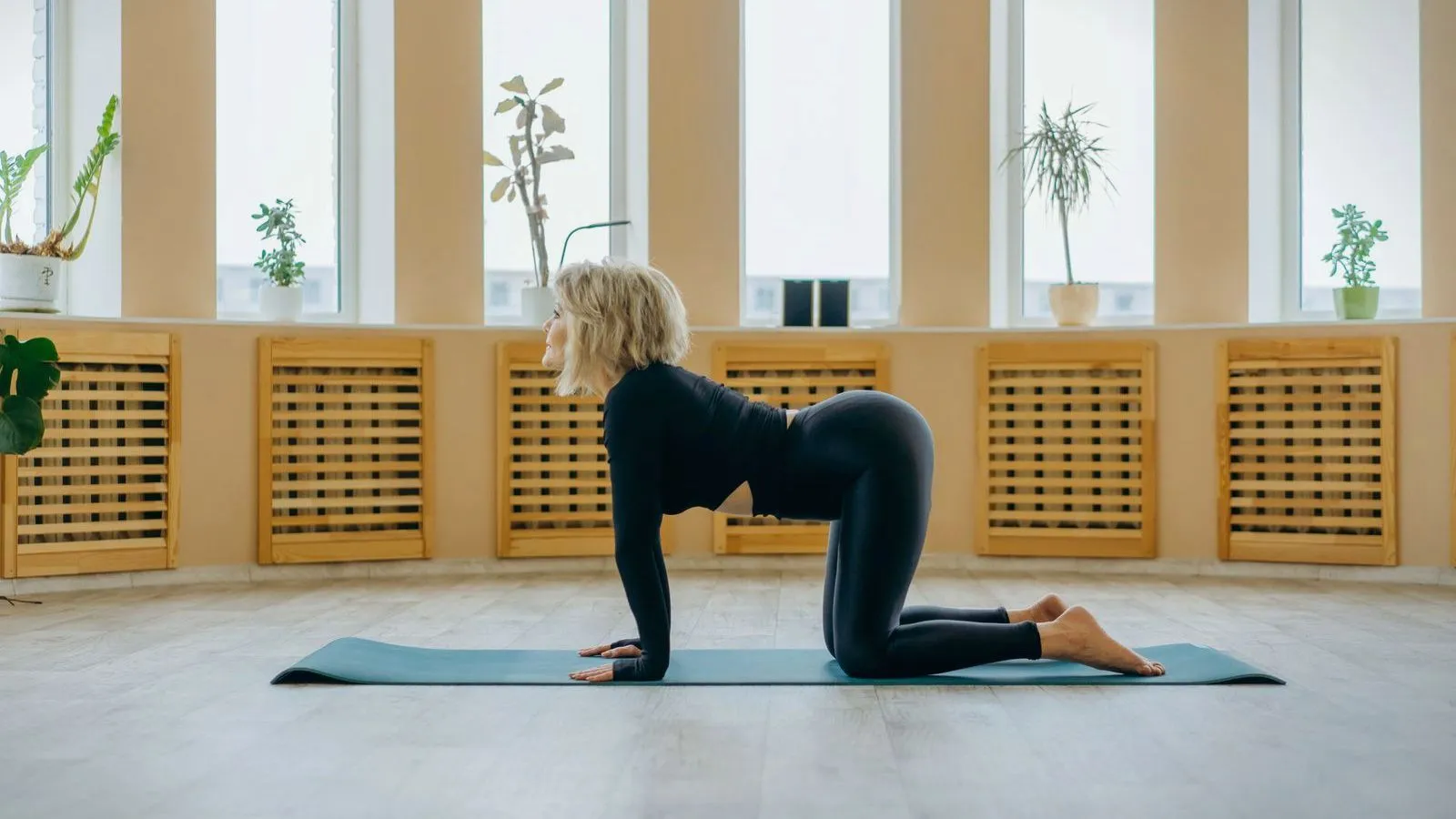
- Across 21 trials, yoga improved back function and pain a little more than no exercise at three months.
- The gains were smaller than the amount researchers count as noticeable to patients.
- Yoga did about as well as physical therapy and stretching classes in head-to-head trials.
- About 4 in 100 people doing yoga reported worse back pain, against about 1 in 100 doing no exercise.
- No trial could hide who was doing yoga, and results were rated by the participants themselves.
A back that has ached for months is one of the commonest reasons people try yoga, and one of the commonest reasons a physical therapist or family doctor suggests it. The idea has official backing. For chronic low back pain the American College of Physicians says clinicians and patients should initially select nonpharmacologic treatment with exercise or one of a list of alternatives, and yoga is on the list.
Backing is not the same as a large effect. When Cochrane, the international group that produces systematic reviews of medical evidence, pooled every randomized trial, it found that yoga does help, by an amount most patients would struggle to notice, and that it performs about as well as any other form of back exercise. That turns out to be a more useful finding than it sounds.
How much does yoga help chronic low back pain?
Susan Wieland of the University of Maryland and co-authors searched for trials in adults whose low back pain had lasted three months or more and had no specific cause such as a fracture or a trapped nerve. In their words, “We included 21 trials (2223 participants) from the USA, India, the UK, Croatia, Germany, Sweden, and Turkey.”
The clearest comparison is with doing no exercise at all: staying on a waiting list, getting usual care or receiving a booklet. Against that, yoga came out ahead at three months on both main measures. Function was scored on a 24-point questionnaire about everyday tasks such as dressing, walking and sleeping, and yoga improved it by a little under 2 points. Pain was scored from 0 to 100, and yoga improved it by about 4.5 points.
Those numbers need a benchmark. Researchers define a minimal important difference for each scale, the smallest change a patient is likely to feel. For the function questionnaire it is 5 points and for the pain scale 15. Yoga’s average effect reached about a third of each. The reviewers therefore wrote that there may be a small clinically unimportant improvement in back-specific function with yoga.
Averages hide spread. When participants were simply asked whether their back had improved or resolved, those doing yoga were about twice as likely to say yes. The reviewers rated that evidence as low certainty.
Is yoga better than other exercise for back pain?
For someone choosing between a yoga class and a course of physical therapy, the answer from the trials is that it makes little difference. The Cochrane authors concluded that there is probably little or no difference between yoga and other back-related exercise for back-related function at three months.
Individual trials show the same thing in more detail. At Boston Medical Center, Robert Saper’s team enrolled 320 predominantly low-income, racially diverse adults and assigned them to 12 weekly yoga classes, 15 physical therapy (PT) visits or an educational book. Yoga matched physical therapy for function and pain, and people in both groups were about 20 percentage points less likely to be using pain medication at 12 weeks than those given the book. One result cut the other way: on the trial’s main measures, yoga was not superior to education for either outcome.
An earlier trial in Seattle, led by Karen Sherman, pitted yoga against a class of conventional stretching. Its conclusion was that yoga classes were more effective than a self-care book, but not more effective than stretching classes. In the United Kingdom, Helen Tilbrook and colleagues at the University of York tested a 12-class program against usual care in 313 adults. The yoga group had better back function at 3, 6, and 12 months than the usual care group, while pain scores were similar.
This fits the wider evidence on exercise. A separate Cochrane review of all exercise therapy for the condition found that exercise is probably effective for treatment of chronic low back pain compared to no treatment, usual care or placebo, with average effects that were also modest. Yoga looks like one more way of doing the thing that helps, which is moving.
Can yoga make back pain worse?
It can, and the trials counted how often. Compared with no exercise, the Cochrane review found that yoga increased the risk of adverse events, primarily increased back pain. Over six to 12 months that meant about 43 people in every 1,000 doing yoga against 9 in every 1,000 doing nothing. Against other exercise the rates were alike, at 84 and 91 per 1,000.
A broader safety review reached the same balance. Holger Cramer and colleagues examined trials of yoga for any condition; of 301 identified randomized controlled trials of yoga, 94 had recorded harms. Their conclusion was that yoga appears as safe as usual care and exercise, with more minor complaints than a purely educational program and no excess of serious ones. In the Boston trial the problems were described as mostly mild self-limited joint and back pain.
What kind of yoga did the back pain trials use?
Styles that emphasize posture, alignment and controlled movement. The review reports that most trials used iyengar, hatha, or viniyoga yoga, typically taught as a weekly class for about three months, often adapted for people with back problems and often with home practice in between.
The participants were a particular group too. Most were women in their 40s or 50s. The findings say less about men, about older adults and about the vigorous or heated styles sold in many studios.
Does yoga help balance and strength in older adults?
A meta-analysis published in September 2026 looked at that separate claim. Its authors found 21 studies involving 1471 unique participants, all older adults. First-pass results suggested gains in leg strength, in balance while moving and in quality of life.
The authors then applied a standard correction for publication bias, the tendency for positive studies to be published more readily than negative ones. Two of the three results weakened. They report that the apparent gains in balance and strength shrank or vanished once the correction was applied, while the quality-of-life estimate remained unchanged.
Where yoga sits in back pain guidelines
The American College of Physicians guideline, published in 2017, gives a strong recommendation that non-drug options come first for chronic low back pain. It names exercise, multidisciplinary rehabilitation, acupuncture and mindfulness-based stress reduction as supported by moderate-quality evidence, and a second group, including tai chi, yoga and spinal manipulation, as supported by low-quality evidence. Medicines come later in its sequence.
The Cochrane authors put the choice in terms of circumstances. With results this close, they write, decisions to use yoga instead of no exercise or another exercise may depend on availability, cost, and participant or provider preference.
No sham yoga: why the back pain evidence is hard to firm up
A drug trial can use a dummy pill. There is no convincing dummy yoga class, and the reviewers state it plainly: “We found no trials comparing yoga to sham yoga.” Everyone in these trials knew what they were doing, and the outcomes were questionnaires they filled in themselves. People who have chosen to try yoga and hope it will work may rate their pain a little lower for that reason alone.
Most of the evidence also stops at three months, and it covers back pain with no identified cause. Pain that follows an injury, or that comes with leg weakness, numbness or other symptoms, is a different clinical problem that a doctor assesses directly.
Low back pain has been the leading cause of disability globally for at least the past three decades, and no single treatment has a large effect on it. Yoga has a small one, similar to other exercise, with an occasional flare of pain as its main risk.
People also ask
How much does yoga improve chronic low back pain?
Compared with no exercise at three months, yoga improved back-specific function by 1.69 points on the 0 to 24 point Roland-Morris Disability Questionnaire (95% CI 0.65 to 2.73) and pain by 4.53 points on a 0 to 100 scale (95% CI 2.46 to 6.61). The review authors set 5 points and 15 points as the smallest changes that matter to patients, so both effects fall short of that.
Is yoga better than physical therapy or other exercise for back pain?
Trials have found little or no difference. The Cochrane review found a difference in function of 0.38 points on the 24-point scale between yoga and back-focused exercise, and a trial of 320 adults found yoga noninferior to physical therapy, meaning no worse by more than a preset margin.
Can yoga make back pain worse?
Sometimes. In the Cochrane review, adverse events, mainly increased back pain, occurred in 43 per 1,000 people doing yoga and 9 per 1,000 doing no exercise over six to 12 months. Rates were similar for yoga and other exercise, at 84 and 91 per 1,000.
What type of yoga was used in the trials?
Most trials used iyengar, hatha or viniyoga yoga, usually as weekly classes over about 12 weeks, and most participants were women in their 40s or 50s.
What do guidelines say about yoga for low back pain?
The American College of Physicians guideline says that for chronic low back pain, clinicians and patients should initially select nonpharmacologic treatment, and it lists yoga among the options, graded as low-quality evidence. This is general information rather than medical advice.
References
- Wieland, L. S., Skoetz, N., Pilkington, K., Harbin, S., Vempati, R., Berman, B. M. Yoga for chronic non-specific low back pain. Cochrane Database of Systematic Reviews, 2022.
- Saper, R. B., Lemaster, C., Delitto, A., et al. Yoga, Physical Therapy, or Education for Chronic Low Back Pain. Annals of Internal Medicine, 2017.
- Sherman, K. J., et al. A Randomized Trial Comparing Yoga, Stretching, and a Self-care Book for Chronic Low Back Pain. Archives of Internal Medicine, 2011.
- Tilbrook, H. E., Cox, H., Hewitt, C. E., et al. Yoga for Chronic Low Back Pain. Annals of Internal Medicine, 2011.
- Qaseem, A., Wilt, T. J., McLean, R. M., Forciea, M. A. Noninvasive Treatments for Acute, Subacute, and Chronic Low Back Pain: A Clinical Practice Guideline From the American College of Physicians. Annals of Internal Medicine, 2017.
- Cramer, H., Ward, L., Saper, R., Fishbein, D., Dobos, G., Lauche, R. The Safety of Yoga: A Systematic Review and Meta-Analysis of Randomized Controlled Trials. American Journal of Epidemiology, 2015.
- Guo, P., Chen, S., Zou, J., Ji, F., Wenju, L. Effects of yoga on lower-extremity muscle strength, balance, and quality of life across diverse older adult populations: A systematic review and Meta-analysis. Experimental Gerontology, 2026.
- Hayden, J. A., Ellis, J., Ogilvie, R., Malmivaara, A., van Tulder, M. W. Exercise therapy for chronic low back pain. Cochrane Database of Systematic Reviews, 2021.