News · Fitness & Exercise
Baduanjin qigong eased anxiety in people with glaucoma, but no eye pressure was measured
112 people with primary glaucoma were randomized to eight weeks of Baduanjin or to routine care alone. Anxiety, depression and sleep scores improved in the exercise group. No eye pressure or vision outcome was measured.
- Primary glaucoma is the leading cause of irreversible vision loss worldwide.
- 112 patients, eight weeks of Baduanjin at five 30-minute sessions a week, or routine care.
- Anxiety, depression and sleep quality all improved more in the exercise group.
- Nothing about eye pressure, visual field or disease progression was measured.
- Gains were largest in those worst off at baseline, which regression predicts anyway.
Glaucoma takes sight slowly and from the edges inward. Without treatment, you slowly lose your peripheral vision, and it may seem like you’re looking through a tunnel.
Knowing that is happening to you, and that the part already gone is not coming back, does something to a person. Beyond visual impairment, glaucoma is frequently associated with anxiety, depression, reduced sleep quality, and diminished quality of life.
At a hospital in Chengdu, Zeng and colleagues tried treating that second problem with an eight-week course of slow exercise, and it worked. What nobody looked at was whether anything happened to the eyes.
Eight weeks of Baduanjin, the eight brocades
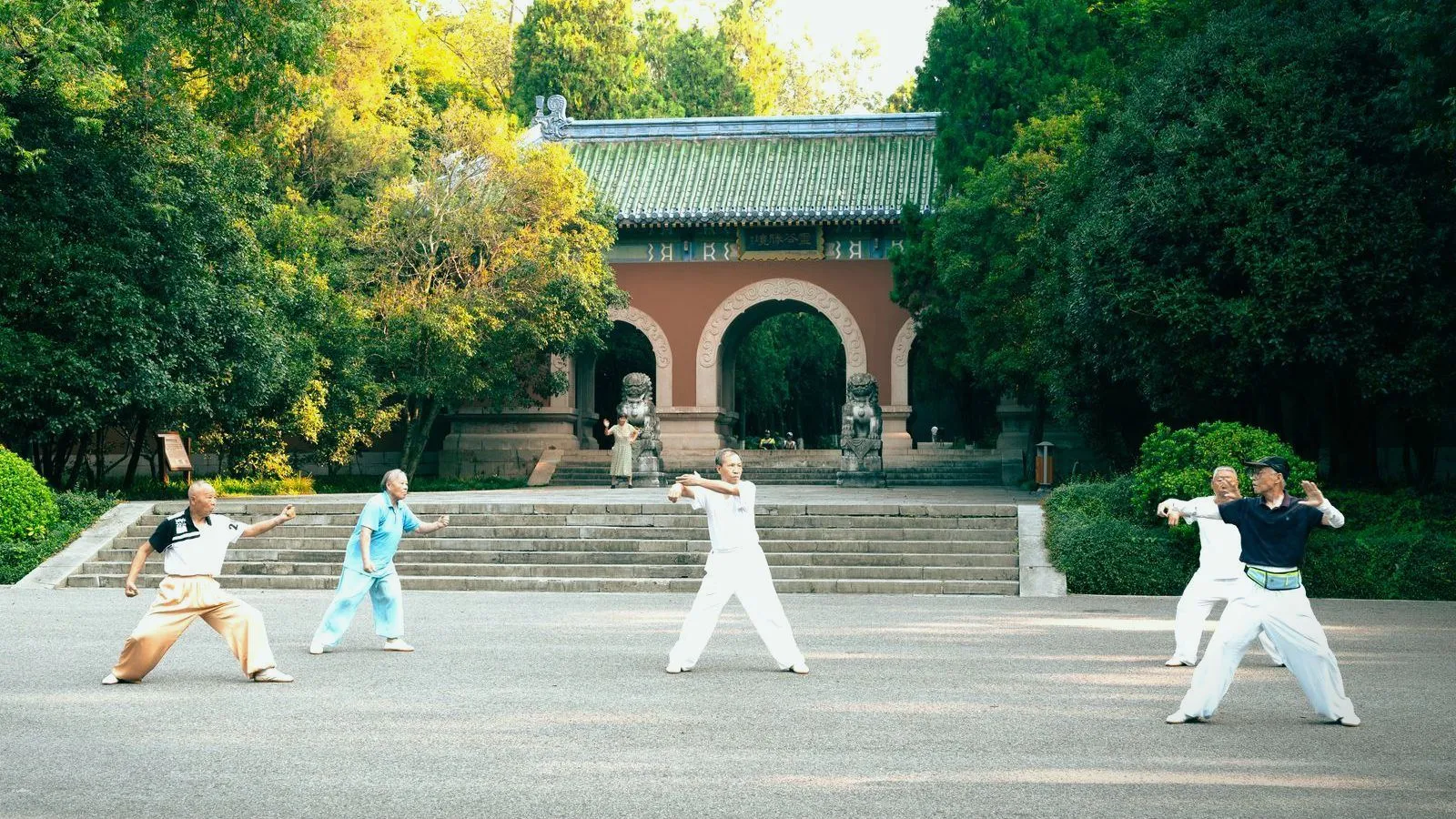
Baduanjin translates roughly as the eight pieces of brocade, a set of eight slow movements that belongs to the qigong family. The National Center for Complementary and Integrative Health groups these with yoga as meditative movement practices, describing tai chi and qigong as practices involving slow gentle movements and physical postures, a meditative state of mind, and controlled breathing.
The dose here was serious. The Baduanjin group received an 8-week intervention with five 30-min sessions per week, in addition to routine care, which comes to two and a half hours a week for two months.
The comparison group got standard glaucoma management and regular follow-up and nothing added.
Of 112 patients enrolled, 102 completed the 8-week intervention and follow-up.
What improved in the glaucoma group
On the questionnaires, the exercise group pulled ahead across the board. The Baduanjin group showed significantly greater improvements in anxiety, depressive symptoms, and sleep quality than the control group, measured with the Hospital Anxiety and Depression Scale and the Pittsburgh Sleep Quality Index.
Two quality-of-life domains moved as well, and the pair the authors name is oddly specific: glare and dark adaptation, and outdoor mobility.
That second one is easy to picture. Someone whose peripheral vision is going becomes frightened of curbs, of stairs, of crossing roads at dusk, and stops going out. Eight weeks of practicing slow, balanced, deliberate movement is a plausible route to feeling steadier on your feet, and feeling steadier is most of what gets a person back outdoors.
Nothing in the trial tests whether they saw better. The improvement is in confidence and function, which is a real thing to improve.
The glaucoma outcome that is missing
Read the assessment list and notice what is absent: the Hospital Anxiety and Depression Scale, the Pittsburgh Sleep Quality Index, and the Chinese version of the Glaucoma QoL-15.
No intraocular pressure. No visual field. No optic nerve imaging.
That is a defensible choice for a trial about psychological wellbeing, and it sets a hard boundary on what the result can mean. Glaucoma damages the optic nerve of one, or both, of your eyes, usually when fluid pressure inside the eye slowly rises, and treatments that lower eye pressure help slow the disease. This trial did not go near that mechanism.
So the honest summary is that Baduanjin appears to help people cope with having glaucoma. Anyone who reads it as help for glaucoma has read it wrong, and the consequence of that particular misreading is somebody easing off their drops.
Why the Baduanjin subgroup claim is the weakest
The authors report that benefits are more pronounced in those with higher baseline symptom burden, and offer it as evidence the intervention is well targeted.
It is the finding to trust least, because that pattern arrives uninvited.
Anxiety and sleep scores bounce around from week to week. Pick out the people who scored worst on the day they enrolled and you have selected, in part, for people caught on a bad day. Measure them again eight weeks later and many will have drifted back toward their own average, with no treatment involved. The subgroup with the most room to improve is also the subgroup where ordinary fluctuation looks most like a response.
A control group protects against this, which is why randomizing was the right call. But a subgroup comparison defined by baseline severity reintroduces the problem inside the analysis, and the abstract does not describe a method for handling it.
What would make the Baduanjin case convincing
An active control, first. The comparison group here did nothing extra, so eight weeks of structure, supervision and expectation are bundled into the effect. Stretching, a walking group, or a health education class would separate the practice from the program.
Longer follow-up, second. The measurement stops at eight weeks, and glaucoma is a lifelong condition. Whether people keep practicing after the trial staff go away is the question that decides whether any of this matters in a decade.
And a single ophthalmology department in one Chinese city, over ten months, is a starting point rather than a general finding.
Even so, the direction of travel is worth something. The adjective doing the work in the authors’ own summary is adjunctive. Regular eye exams by an eye care provider can check for glaucoma and other eye problems to help protect your vision, and the pressure-lowering treatments discussed above remain what protects sight. Zeng and colleagues write that Baduanjin is a scalable non-pharmacological adjunctive intervention, and this is about the rest of the experience, which patients rarely get offered anything for at all.
People also ask
What did the trial test?
Baduanjin, a traditional Chinese mind-body exercise, added to standard glaucoma care. A total of 112 patients with primary glaucoma were randomly assigned 1:1 to either the Baduanjin exercise group (n = 56) or the routine care control group (n = 56), with the exercise group doing an 8-week intervention of five 30-minute sessions per week in addition to routine care.
What did it find?
After the intervention, the Baduanjin group showed significantly greater improvements in anxiety, depressive symptoms, and sleep quality than the control group. The authors also report improvement in two specific quality-of-life domains, glare and dark adaptation, and outdoor mobility.
Did it do anything for the glaucoma itself?
Unknown, because it was not measured. Assessments used the Hospital Anxiety and Depression Scale, the Pittsburgh Sleep Quality Index and the Chinese version of the Glaucoma QoL-15. There is no intraocular pressure reading, no visual field test and no measure of optic nerve damage anywhere in the outcomes.
Why does the 'more pronounced in those with higher baseline symptom burden' finding need care?
Because that pattern appears in data whether or not a treatment works. People who score worst on a questionnaire at one sitting tend to score better at the next one, partly because extreme scores drift back toward a person's average. A subgroup defined by having the worst baseline is the subgroup most likely to show a large change regardless.
What was the control group doing?
The routine care control group received routine care, including standard glaucoma management and regular follow-up. They were not given an alternative activity, so the trial cannot separate the exercise from the effect of being in a structured program for eight weeks.
How many finished?
A total of 102 patients completed the 8-week intervention and follow-up and were included in the analysis, out of 112 enrolled.
Should someone with glaucoma take this up?
As something for the distress, not the disease. Treatments that lower eye pressure help slow glaucoma, and without treatment it can eventually lead to blindness, so nothing here replaces drops, laser or surgery. Gentle movement alongside that is low-risk for most people. This is general information rather than medical advice, and any exercise plan is worth checking with an eye specialist first.
References
- Zeng, Z., Li, X., Ma, X., Guo, J., Qin, L. Effects of Baduanjin on anxiety, depressive symptoms, and quality of life in patients with primary glaucoma: A randomized controlled trial. Complementary Therapies in Clinical Practice, 2026.
- MedlinePlus. Glaucoma. US National Library of Medicine.
- National Center for Complementary and Integrative Health. Tai Chi and Qi Gong: In Depth. US National Institutes of Health.