News · Nutrition & Diet
Vegetarian diet built muscle in over-55s who lifted weights, but less than a meat diet in a 108-person trial
In a Dutch trial, 108 adults aged 55 and over did 12 weeks of resistance training on a mostly plant-protein or mostly animal-protein diet. Both groups gained muscle and strength; the vegetarians ate less protein and gained less muscle.
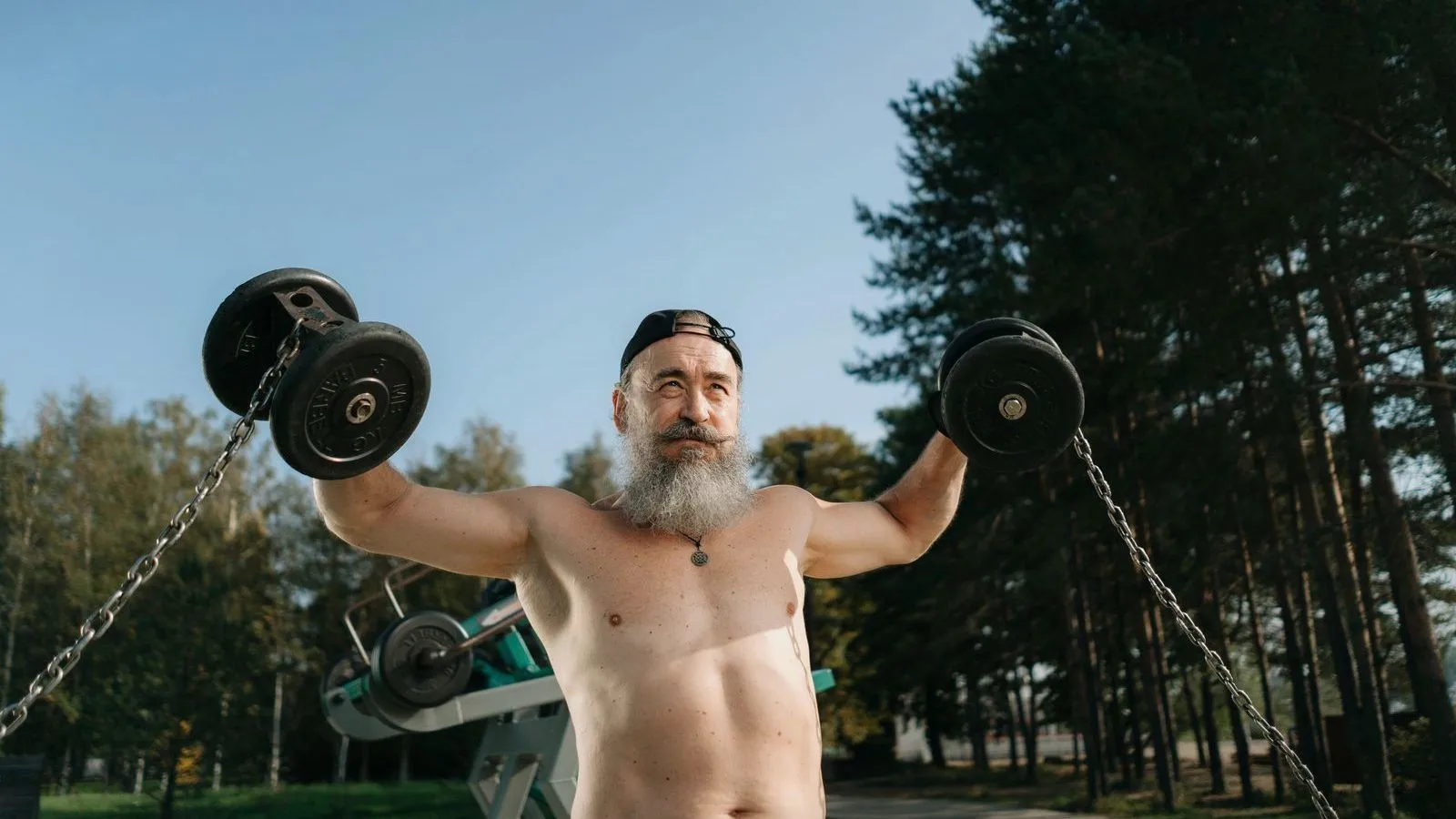
- 108 adults aged 55 and over lifted weights for 12 weeks on a vegetarian or an omnivorous diet.
- Both groups gained muscle and got stronger. The omnivores gained somewhat more muscle.
- The vegetarians ate less protein, though still above the level advised for active older adults.
- A second Dutch trial found that a vegan diet without exercise cost older adults muscle.
- Twelve weeks in healthy volunteers says little about frailer people or strict vegan diets.
Muscle gets harder to hold on to with age, and the standard advice for keeping it has two parts: lift something heavy and eat enough protein. Meat, fish, eggs and dairy make the second part easy. More older adults are now eating less of them, for their health or for the planet, and it has been unclear whether the muscle advice still works without them.
A randomized trial from Amsterdam University of Applied Sciences, published in the American Journal of Clinical Nutrition in September, put the question to 108 people aged 55 and over. All of them did 12 weeks of resistance training. Half ate a vegetarian diet and half an omnivorous one. Everyone ended up with more muscle and more strength, but the vegetarians ate less protein and the trial could not show that their muscle gain kept pace.
What did the vegetarian diet trial test?
Sophie van Oppenraaij, Peter Weijs and Sjors Verlaan recruited adults with a typical age of 66, a little over half of them women. Each person received dietary counseling for either a lacto-ovo vegetarian or an omnivorous diet. Lacto-ovo means no meat or fish, with dairy and eggs still on the plate.
Nobody was handed a meal plan. Participants chose their own food toward two targets: at least 1.2 grams of protein per kilogram of body weight a day, and at least 60% of that protein from plants in one group or from animal foods in the other. Alongside the diet, everyone completed a 12-week resistance training program of three sessions a week.
The design had a specific question built in. It was a non-inferiority trial, which asks whether a new option is no worse than the usual one by more than a margin fixed in advance. Here the margin for muscle was a quarter of a kilogram.
Did the vegetarian group build as much muscle?
Both diets hit their marks, and still a gap opened. The vegetarians averaged 1.24 grams of protein per kilogram a day, three-quarters of it from plants. The omnivores averaged 1.58. For someone weighing 70 kilograms, that is roughly 87 grams of protein a day against 111, a gap of about the protein in a small chicken breast.
Muscle followed the same pattern. Scans showed the muscle of the arms and legs grew on either diet, by about 0.4 kilograms in the vegetarians and about 0.7 in the omnivores. On the trial’s own test, non-inferiority of the vegetarian diet was not established. The vegetarians may have gained somewhat less, and the trial could neither confirm a real shortfall nor rule one out.
What people could do with that muscle did not differ. Leg press strength and the time taken to stand up repeatedly from a chair got better in both groups, with no between-group differences. The authors’ own summary gives both halves: both groups achieved the protein target and improved muscle mass, strength, and function during resistance training.
How this fits with other trials of plant protein and muscle
A second Dutch trial, published in the same journal a month earlier, shows what happens when the exercise is taken away. Jacintha Domić and colleagues at Wageningen University studied 72 healthy older adults aged 65 and over, who were randomly assigned to follow a self-selected vegan diet, their usual omnivorous diet, or the vegan diet plus resistance exercise. The vegan group’s protein intake dropped, and over 12 weeks so did their thigh muscle and limb lean mass, compared with the omnivores, in which protein intake did not change. Adding exercise roughly halved the loss without removing it.
Across the wider literature the difference between plant and animal protein is small. A 2025 meta-analysis in Nutrition Reviews from Queen’s University Belfast combined randomized trials and found that, compared with animal protein, plant protein resulted in lower muscle mass following the intervention. The effect was slight, it was weaker in older than in younger adults, and it did not show up for strength or physical performance. Soy held its own: there was no pooled effect difference between soy and milk protein for muscle mass.
Two training studies in young adults point to what may sit underneath. In Brazil, habitual vegans and omnivores were both brought to the same high protein intake and trained for 12 weeks. The researchers concluded that protein source does not affect resistance training-induced adaptations in untrained young men consuming adequate amounts of protein. A British trial that matched protein at an even higher level found that resistance training increased lean mass in both groups by a similar magnitude.
Set side by side, these results suggest a pattern. Where plant and animal diets supply the same amount of protein, muscle responds about equally. Where people choose their own plant-based food and end up eating less protein, as in both Dutch trials, muscle falls behind. That reading is ours, drawn across separate studies, and no single trial has tested it directly in older adults.
What twelve weeks in healthy older adults leave open
The Amsterdam volunteers were healthy, mostly in their sixties and of average weight. People who are frail, ill or much older lose muscle faster and may respond differently. The diet kept eggs and dairy, so it says nothing direct about vegan eating. And 12 weeks is long enough to see muscle grow but too short to show whether a small difference widens, holds or disappears over years.
Protein intake came from three-day food records, which rely on people writing down what they eat. Because the two diets differed in both the source and the amount of protein, the trial has no way to separate one from the other.
One reference point helps place the numbers. The PROT-AGE study group, convened by European geriatric medicine societies, holds that older adults need more dietary protein than do younger adults and recommends an average daily intake at least in the range of 1.0 to 1.2 g protein per kilogram of body weight per day, with more for people who exercise. The vegetarian group in Amsterdam cleared that level on food they chose themselves.
Older adults in this trial built muscle with or without meat, and possibly a little less of it without.
People also ask
How much muscle did each group gain?
Appendicular muscle mass, the muscle of the arms and legs measured by body scan, rose by 0.38 kg in the vegetarian group and 0.66 kg in the omnivorous group over 12 weeks. The difference was 0.33 kg in favor of the omnivores (95% CI -0.69 to 0.03), and the trial could not show the vegetarian diet was non-inferior, meaning no worse by more than a preset margin of 0.25 kg.
How much protein did the two groups eat?
The vegetarian group averaged 1.24 grams of protein per kilogram of body weight a day, 76% of it from plants. The omnivorous group averaged 1.58 grams per kilogram, 67% of it from animal foods. Both were above the trial's target of 1.2.
Did strength differ between the diets?
No. Leg press strength and the chair stand test improved in both groups, with no between-group differences.
What is a lacto-ovo vegetarian diet?
A diet without meat or fish that still includes dairy foods and eggs. It differs from a vegan diet, which excludes all animal products.
What do expert groups say about protein for older adults?
The PROT-AGE study group, convened by the European Union Geriatric Medicine Society, recommends an average of at least 1.0 to 1.2 grams of protein per kilogram of body weight a day for people over 65, and 1.2 or more for those who are exercising. It notes that people with severe kidney disease may need to limit protein. This is general information rather than medical advice.
References
- van Oppenraaij, S. L., Weijs, P. J. M., Verlaan, S. Effects of a self-selected vegetarian vs. omnivorous diet on protein intake and muscle mass in older adults during resistance exercise: the IMPACT randomized controlled trial. American Journal of Clinical Nutrition, 2026.
- Domić, J., Grootswagers, P., Pinckaers, P. J. M., Melchers, M., van Loon, L. J. C., de Groot, L. C. P. G. M. A self-selected vegan diet reduces skeletal muscle mass in healthy older adults: a randomized controlled trial. American Journal of Clinical Nutrition, 2026.
- Reid-McCann, R. J., Brennan, S. F., Ward, N. A., Logan, D., McKinley, M. C., McEvoy, C. T. Effect of Plant Versus Animal Protein on Muscle Mass, Strength, Physical Performance, and Sarcopenia: A Systematic Review and Meta-analysis of Randomized Controlled Trials. Nutrition Reviews, 2025.
- Hevia-Larraín, V., Gualano, B., Longobardi, I., et al. High-Protein Plant-Based Diet Versus a Protein-Matched Omnivorous Diet to Support Resistance Training Adaptations: A Comparison Between Habitual Vegans and Omnivores. Sports Medicine, 2021.
- Monteyne, A. J., Coelho, M. O. C., Murton, A. J., et al. Vegan and Omnivorous High Protein Diets Support Comparable Daily Myofibrillar Protein Synthesis Rates and Skeletal Muscle Hypertrophy in Young Adults. Journal of Nutrition, 2023.
- Bauer, J., Biolo, G., Cederholm, T., et al. Evidence-Based Recommendations for Optimal Dietary Protein Intake in Older People: A Position Paper From the PROT-AGE Study Group. Journal of the American Medical Directors Association, 2013.