News · Heart & Metabolic
Eating beside a partner blunted the blood sugar rise after a meal in 108 healthy young adults
Hebrew University researchers gave 54 couples the same bread to eat alone and together. Blood sugar rose less and settled faster with a partner present, in a laboratory experiment that measured two hours and no long-term health outcome.
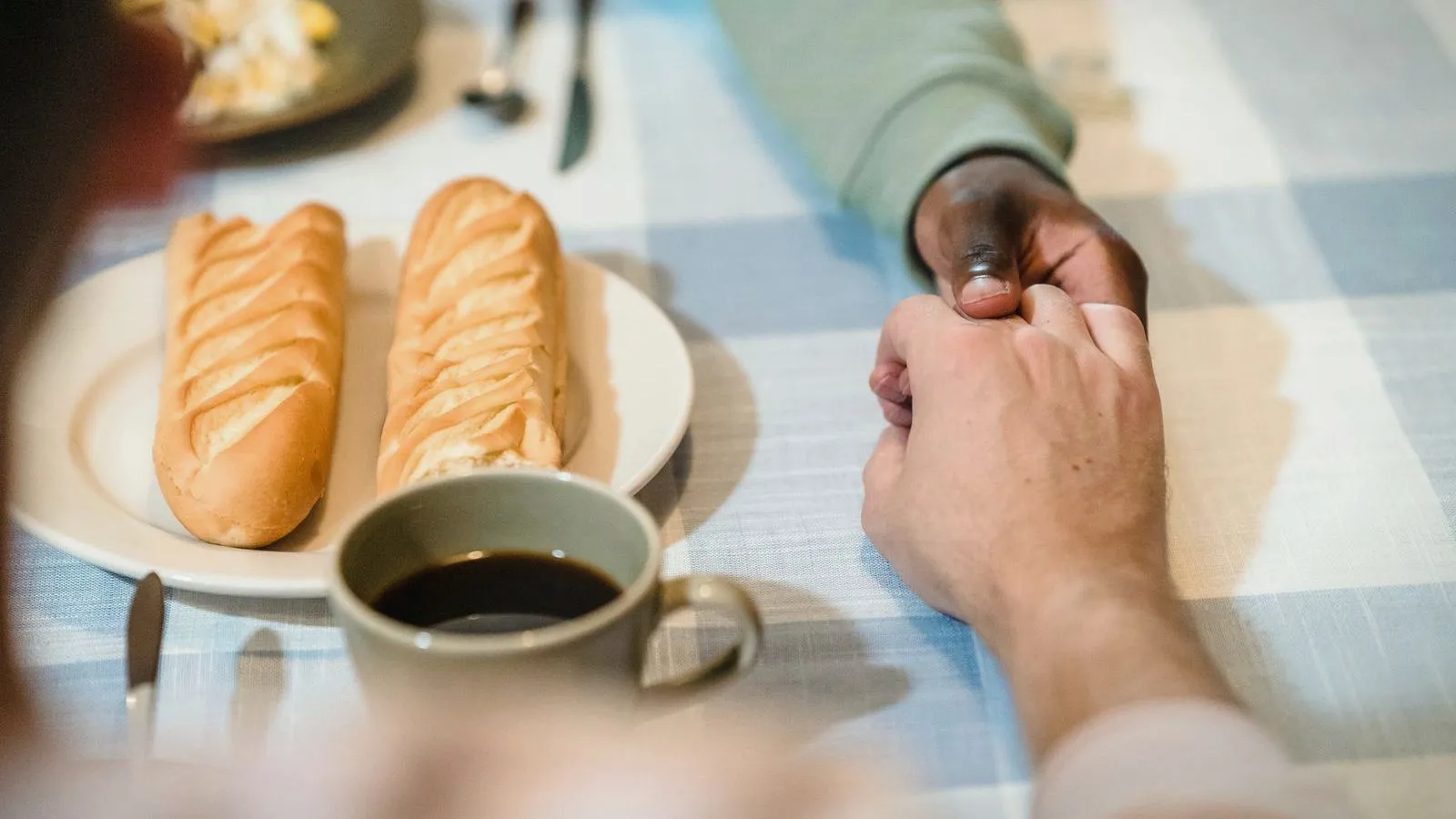
- This was a lab experiment in 108 healthy young adults, tested as 54 romantic couples.
- After identical servings of bread, the blood sugar rise was about 15% smaller with a partner in the room.
- Recovery from a cold room showed a similar pattern. The result for mild electric shocks was less clear.
- Neither touch nor a measure of stress accounted for the blood sugar difference.
- Nobody had diabetes, the effect was measured over two hours, and some people did worse with their partner.
Fifty-four couples came to a laboratory in Jerusalem to eat bread. Each person ate the same plain white portion twice in one day, once sitting alone and once with their partner beside them, while a finger-prick meter tracked their blood sugar for two hours afterward. These were 108 healthy adults in their twenties and thirties, and the question was whether a basic bodily process that nobody thinks of as social would behave differently in company.
It did. Monia Masalha, Shir Atzil and colleagues at the Hebrew University of Jerusalem report in Science Advances that blood sugar rose less, and came back down sooner, when the partner was in the room. Decades of population research have tied strong relationships to better health over years. What had not been shown is another person’s presence changing how the body handles a meal in the moment. The result comes from a short laboratory test in young couples and it is no guide to managing blood sugar, but it is a striking thing to find.
What did the couples eat, and what happened to their blood sugar?
The test was a standard one borrowed from nutrition research. In the paper’s words, participants consumed 50 g of carbohydrates by eating 102 g of a standardized white-wheat bread. Everyone who took part had been screened to rule out diabetes and the raised blood sugar that often comes before it.
Partners were tested as pairs. Participants were part of heterosexual couples in monogamous relationships of at least 9-month duration, and the testing room was furnished like a living room, with a sofa and a carpet. In the shared session nothing was scripted: partners were free to talk and touch at their discretion. In the solo session each person sat through the same two hours alone. The order was decided at random, and the sessions were at least four hours apart.
To compare the two, the team added up how far and for how long each person’s blood sugar stayed above the normal fasting level. That total was smaller with company, by an average the paper gives as a 14.55% mean reduction in the Social versus Alone conditions. The two curves started in the same place. Glucose levels were comparable across conditions during the baseline and diverged following the meal, with the gap clearest at about an hour.
An obvious worry is that people simply eat more slowly when they have someone to talk to, which would flatten the rise for dull reasons. The researchers timed the eating and checked. The difference held after allowing for eating time, for which session came first and for body weight.
Was touch or lower stress behind the blood sugar effect?
Two ordinary explanations come to mind: partners touch each other, and people feel calmer with someone they trust. The experiment was built to test both.
For stress, each participant wore sensors that track tiny changes in sweat on the skin, a standard readout of the body’s alarm system. Eating bread turned out not to be alarming, and the readings were the same in both sessions. The authors conclude that the homeostatic advantage observed in the Social condition was independent of physiological stress. Homeostasis is the body’s constant work of keeping things such as blood sugar and temperature within safe limits.
For touch, the sessions were filmed and contact between partners was scored. More touching did not go with a smaller blood sugar rise. Across the whole study, the team writes, touch was not a reliable mediator of the Social Physiology effects across experiments, a mediator being the step through which an effect travels.
That leaves the finding without a mechanism. Something about a partner’s presence changed how the body cleared sugar, and the study does not say what.
Did social proximity help with cold and stress too?
The blood sugar test was one of three run on adults, with 180 people taking part across them. In the second, participants entered a cold room at 12°C for 5 min, about 54°F and roughly a chilly autumn morning in light clothes, and sensors on the wrist tracked how far skin temperature fell and how fast it recovered. With a partner present the disturbance was about 7% smaller. Here touch did play some part, which is not surprising, though the effect remained when touch was taken into account.
The third experiment delivered two mild electric shocks to the forearm and measured the sweat response. This is the closest of the three to earlier work, and it gave the weakest result. Within the same people the improvement with a partner was under 2% and fell short of the usual statistical standard. A comparison between separate groups did pass.
A pilot study with babies had pointed the same way. When 56 infants heard a sudden loud noise, their alarm response was a little smaller and shorter with their mother close by.
Taken together the three adult experiments show one pattern, strongest for blood sugar and weakest for shocks. The adult experiments were registered in advance, meaning the team published its plan and predictions before collecting the data, which guards against choosing analyses to fit the result.
Why would company change blood sugar?
Atzil frames the result as evidence that the body is built to run with others nearby. “We used to think of the body as an isolated system that regulates itself,” Atzil said in a university statement. “Our findings show that human physiology is inherently social.”
The idea has a history. Social Baseline Theory, set out by the psychologists Lane Beckes and James Coan, proposes that the primary ecology to which human beings are adapted is one that is rich with other humans, so that being alone is the unusual state and costs the body extra effort. The presence of other people, they wrote, helps individuals to conserve important and often metabolically costly somatic and neural resources. Somatic means bodily.
The evidence for that theory came mostly from brains under threat. In Coan’s best-known experiment, 16 married women were subjected to the threat of electric shock while holding their husband’s hand, a stranger’s hand or no hand, inside a scanner. Holding the husband’s hand produced a pervasive attenuation of activation in the neural systems supporting emotional and behavioral threat responses, which is to say the brain’s alarm circuits quietened.
The Jerusalem study pushes the idea somewhere new. Blood sugar after a meal involves no threat and, in this experiment, no measurable stress. The authors suggest the brain may adjust its handling of the body’s resources when it registers a familiar person nearby. They did not test that.
Where the blood sugar experiment fits with research on social ties
Population studies have long linked relationships to survival. A meta-analysis led by Julianne Holt-Lunstad at Brigham Young University pooled results across 148 studies (308,849 participants) and found the equivalent of a 50% increased likelihood of survival for participants with stronger social relationships.
Diabetes follows the same pattern. Among 4112 diabetes-free participants in a long-running English study of older adults, those who scored as lonely were more likely to develop type 2 diabetes over the next decade. The researchers, at King’s College London, concluded that loneliness is a risk factor for type 2 diabetes and added that the mechanisms underlying this relationship remain to be elucidated.
Studies like those cannot separate cause from circumstance, because lonely people differ from others in many ways. The bread experiment is a different kind of evidence. By testing the same person both ways on the same day, it shows that company itself can shift a metabolic reading, at least briefly. Whether brief shifts repeated over years add up to anything is the gap between the two.
Young, healthy couples and two hours of blood sugar readings
The participants were young, lean, free of diabetes and in settled relationships. Nothing here says what would happen in older people, in people whose blood sugar control is already impaired, or with a friend, a colleague or a stranger across the table.
The effect was also measured over minutes and hours. The authors state that the design does not allow conclusions about the stability of these effects over time or their potential accumulation into long-term outcomes. A 15% smaller rise after one meal in a healthy person has no known health consequence.
Partners did not help everyone. The paper notes that a subset exhibited less efficient homeostasis in the Social condition, and cautions that its results do not imply that all close bonds or social contexts uniformly enhance regulation nor that social proximity is invariably beneficial. Anyone who has eaten a tense dinner will not need persuading.
Two further points bear on the result. The team used one-sided statistical tests, as its registered plan allowed, which makes a result easier to reach than the two-sided tests most studies report. And the paper discloses a commercial interest: its senior author is working to explore intellectual property protection related to applications of Social Physiology.
The researchers do not present any of this as a treatment. “Blood sugar regulation is not just about what we eat, but who we eat with,” Atzil said, and the same statement adds that social closeness is not a substitute for medical care, nutrition, or exercise. How blood sugar is managed in anyone with diabetes is a matter for their doctor.
What the experiment shows is narrow: for two hours after one meal, company changed a blood sugar reading in young, healthy couples.
People also ask
How much lower was blood sugar when eating with a partner?
The measure was the area under the glucose curve above 100 mg/dl over 120 minutes. Within the same people it averaged 1926.51 alone and 1576.64 with a partner (in mg/dl multiplied by minutes), a 14.55% reduction (effect size d = 0.30, P = 0.001, n = 108). Comparing separate groups on their first session, the reduction was 23.9%.
Who took part in the blood sugar experiment?
108 adults in 54 heterosexual couples who had been together at least nine months. Adults in the study were aged 18 to 37, had a body mass index between 18 and 30, and were tested to confirm they had neither diabetes nor prediabetes.
Was the effect caused by touch or by feeling less stressed?
Not as far as the study could measure. Touch between partners was not associated with the glucose result, and a skin-conductance measure of stress did not differ between the alone and partner sessions. The effect remained after controlling for both.
Did being with a partner help in the cold and stress experiments?
In the cold-room experiment the within-person reduction was 6.76% (P = 0.03, n = 116). In the adult stress experiment it was 1.89% within persons, which did not reach statistical significance (P = 0.09, n = 115), and 5.98% between groups (P = 0.01). In infants with their mothers it was 2.55% (n = 56).
Can eating with other people treat or prevent diabetes?
The study does not show that. It involved healthy young adults, measured two hours after one meal, and tested no one with diabetes. The researchers state that social closeness is not a substitute for medical care, nutrition or exercise. This is general information rather than medical advice.
References
- Masalha, M., Cohen, M., Aloni, M., et al. Social Physiology: Human homeostasis is more efficient in social proximity. Science Advances, 2026.
- Holt-Lunstad, J., Smith, T. B., Layton, J. B. Social Relationships and Mortality Risk: A Meta-analytic Review. PLoS Medicine, 2010.
- Hackett, R. A., Hudson, J. L., Chilcot, J. Loneliness and type 2 diabetes incidence: findings from the English Longitudinal Study of Ageing. Diabetologia, 2020.
- Coan, J. A., Schaefer, H. S., Davidson, R. J. Lending a Hand: Social Regulation of the Neural Response to Threat. Psychological Science, 2006.
- Beckes, L., Coan, J. A. Social Baseline Theory: The Role of Social Proximity in Emotion and Economy of Action. Social and Personality Psychology Compass, 2011.