News · Sleep
One all-nighter hit driving harder than four short nights
A trial in SLEEP put the same 20 men through a night with no sleep, four nights of two hours less, and normal sleep, then a simulated dawn commute. The all-nighter degraded lane control within minutes. The gradual loss barely showed.
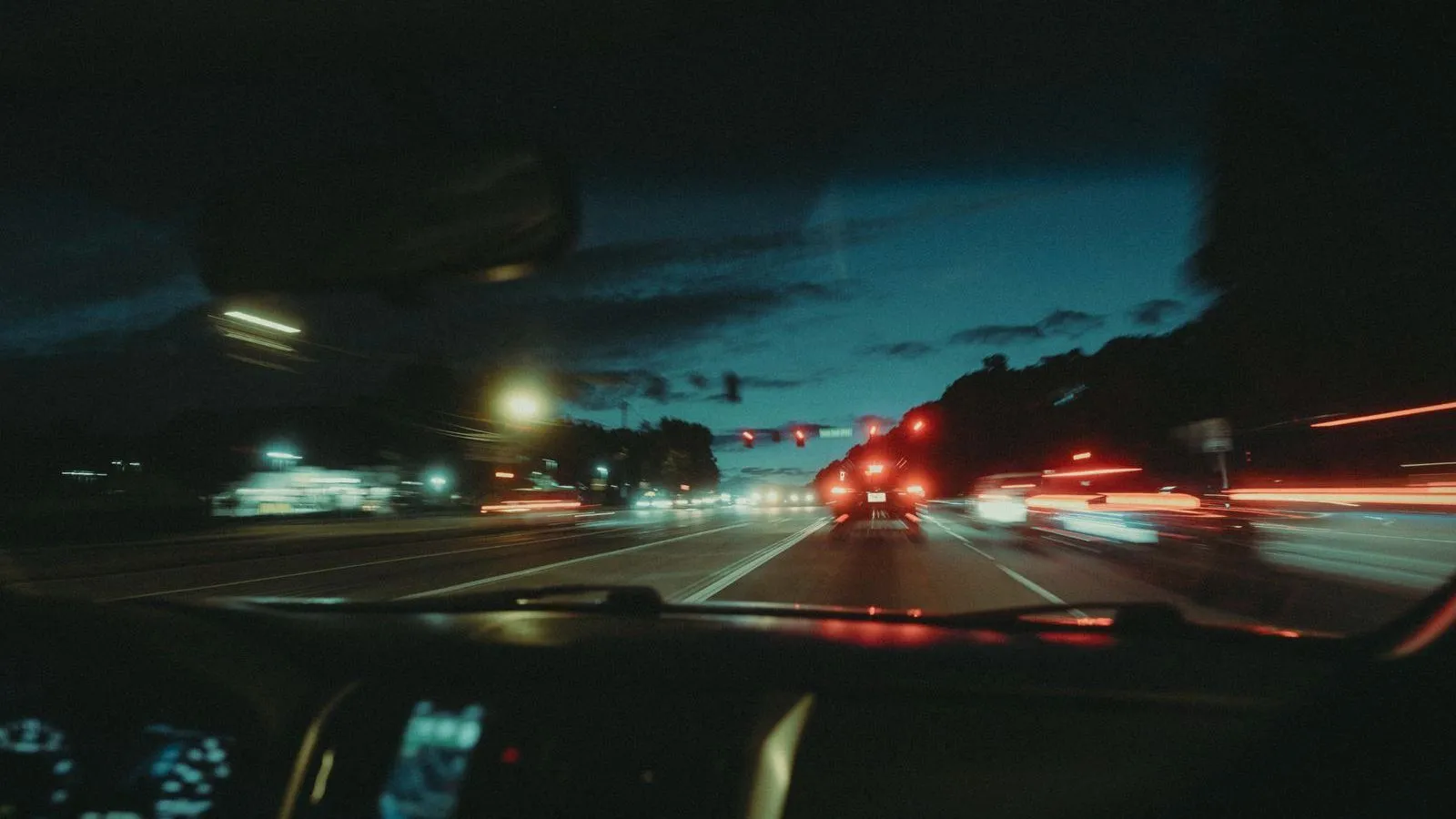
- Two ways of losing eight hours of sleep, one all at once and one spread over four nights.
- Losing it all at once wrecked lane control within 4 to 6 minutes of setting off.
- The authors put that impairment on a par with 1.2 to 1.4 g/L blood alcohol.
- The same eight hours lost gradually produced smaller and less consistent changes.
- Only 20 men, all healthy, in a simulator rather than on a road.
Losing eight hours of sleep is losing eight hours of sleep. That is the assumption behind most safety advice, and behind the way people reason about their own week: a run of short nights and one missed night are both just sleep debt.
A trial published in SLEEP, the journal of the Sleep Research Society, took that arithmetic apart. The differential effects of two common real-world patterns of sleep loss remain poorly quantified, its authors write, so they gave the same 20 people both versions of an eight-hour deficit and put each of them behind the wheel of a driving simulator at the worst hour of the night.
The two were nothing alike.
Why sleep loss and driving are studied together
Sleep deficiency harms your driving ability as much or more than being drunk, which is the standard framing from the National Heart, Lung, and Blood Institute (NHLBI). The toll it puts on that: driver sleepiness is a factor in about 100,000 car accidents each year, resulting in about 1,500 deaths.
The mechanism is partly a matter of attention shutting off in fragments. Microsleep refers to brief moments of sleep that happen when you’re normally awake, and a few seconds of it at speed covers a lot of road.
What has stayed unclear is which pattern of sleep loss does the damage. The NHLBI treats the two as broadly interchangeable: after several nights of losing sleep, even a loss of just 1 to 2 hours per night, your ability to function suffers as if you haven’t slept at all for a day or two.
That equivalence is what this trial set out to test, because the difference had not previously been quantified.
How the sleep and driving trial was run
Twenty healthy male participants completed a randomized within-subject crossover sleep design, meaning every person went through every condition on separate occasions and served as their own comparison.
Three conditions: normal sleep, cumulative sleep restriction (four nights 2 h reduced sleep per night), and acute total sleep deprivation (one night without sleep). Four nights short by two hours is eight hours lost. One night with no sleep is eight hours lost. The debt is identical by design.
Each condition was followed by a simulated nighttime-to-early-morning commute. The drive sits in the window when the body clock is pushing hardest for sleep and when real crashes cluster.
The researchers describe the setup as tightly controlled sleep manipulation and highly immersive driving simulation.
What one missed night did to lane control
The all-nighter was the dangerous condition, and it went wrong fast.
Acute total sleep deprivation produced pronounced impairments in vehicle control. Most prominently, lateral control deteriorated within 4-6 min under acute deprivation. Lateral control is how steadily a car holds its place in the lane, and it began failing before most commutes have left the suburbs.
The comparison the authors reach for is the one everybody understands: impairments comparable to those reported at high blood alcohol concentrations (1.2-1.4 g/L). That is above the legal driving limit everywhere one is set, and roughly double it across much of Europe.
Steering instability and integrated driving performance showed convergent deterioration, so this was not one wobbly measure. The whole picture of vehicle handling degraded together.
Why four short nights looked so different
The same eight hours, taken gradually, barely registered.
Cumulative sleep restriction resulted in smaller and less consistent changes. Vigilance task performance and speed variability were comparatively preserved across all conditions, meaning the reaction-time test researchers usually rely on did not separate the groups at all.
The gap between feeling and performing is the part worth holding onto. Subjective sleepiness increased in a graded way across the conditions, yet cumulative sleep restriction produced only limited changes in driving performance. People felt progressively worse and drove much the same.
The authors’ reading is that acute sleep deprivation produced a disproportionate risk to driving safety by selectively and rapidly degrading operational vehicle control. Something specific breaks when you skip a night, and it is not the same thing that erodes over a short week.
What 20 men in a driving simulator cannot show
The sample is the obvious limit. Twenty healthy male participants, which excludes women, older drivers, shift workers and anyone with a sleep disorder. Those are the groups most exposed to this risk in real life.
A simulator is also not a road. It captures steering and lane position well and cannot reproduce the consequences of getting them wrong, which is the thing that keeps real drivers alert.
Four nights at two hours short is a mild version of chronic restriction. A longer or deeper run might behave more like the all-nighter, and this trial cannot say where that line sits.
What to do about your own night drive
Nothing here suggests a week of short nights is harmless. It suggests the two problems have different shapes, and only one of them arrives all at once.
The practical version is narrow. Driving home at dawn after a night with no sleep is the case this trial identifies as acutely dangerous, and it looked in the simulator like driving well over the limit. Coffee and an open window do not address a failure of lane-keeping that arrives inside six minutes.
A run of short nights is a real problem, and a slower one. It is worth fixing for its own reasons rather than as a road-safety emergency.
The eight hours may be the same on paper. Behind the wheel they are not.
People also ask
What did the trial actually compare?
Twenty healthy male participants completed a randomized within-subject crossover sleep design, meaning each man went through every condition himself rather than being compared with somebody else. The three conditions were normal sleep, cumulative sleep restriction (four nights 2 h reduced sleep per night), and acute total sleep deprivation (one night without sleep), each followed by a simulated nighttime-to-early-morning commute. Both loss conditions remove the same eight hours of sleep; only the schedule differs.
How bad was the all-nighter?
Acute total sleep deprivation produced pronounced impairments in vehicle control. Lateral control deteriorated within 4-6 min under acute deprivation, with impairments comparable to those reported at high blood alcohol concentrations (1.2-1.4 g/L), well above every legal driving limit. Steering instability and integrated driving performance showed convergent deterioration.
What about the four short nights?
Cumulative sleep restriction resulted in smaller and less consistent changes, while vigilance task performance and speed variability were comparatively preserved across all conditions. That is the surprise: an identical eight-hour debt, accumulated slowly, did far less to driving than losing it in one go.
Did people know how impaired they were?
Only partly. Subjective sleepiness increased in a graded way across the conditions, so people did feel worse after both kinds of loss. But cumulative sleep restriction produced only limited changes in driving performance, so the feeling and the driving came apart. Feeling tired is a poor gauge of which kind of tired you are.
What is lateral control?
How steadily a car holds its position within the lane. It is the measure that deteriorates first when a driver is impaired, showing up as weaving and late corrections, and it is what police and researchers watch for. In this trial it was the first thing to go, within the opening minutes of the drive.
How big was the study?
Small: 20 healthy male participants. The design partly compensates, because each person drove after all three sleep conditions, so everyone is compared with their own baseline. That removes most of the variation between people, but it cannot make the sample representative of women, older drivers or anyone with a sleep disorder.
What should I take from this?
That the two situations are not equivalent, even though the arithmetic says they are. This is general information rather than medical advice, but the practical read is that an overnight drive after no sleep at all is the high-risk case and should be avoided outright, while a run of short nights is a slower and more diffuse problem. Anyone routinely driving after night shifts should raise it with an occupational health service.
References
- Lakamper, S., Scholz, M., Kraemer, T., Landolt, H.-P., Keller, K. Commonly experienced acute and cumulative 8-hour sleep loss differentially affect simulated driving during a night-time to early-morning commute: a randomized controlled crossover trial. SLEEP, 2026.
- National Heart, Lung, and Blood Institute. Sleep Deprivation and Deficiency: How Sleep Affects Your Health. US National Institutes of Health.