News · Nutrition & Diet
The sweetener in your sugar-free label is also made by your body, and its level tracks insulin resistance
Erythritol is sold as a sweetener and quietly produced inside us from glucose. In 802 adults on a weight-loss trial, the people whose blood erythritol fell furthest were the ones whose insulin resistance improved most, two years on.
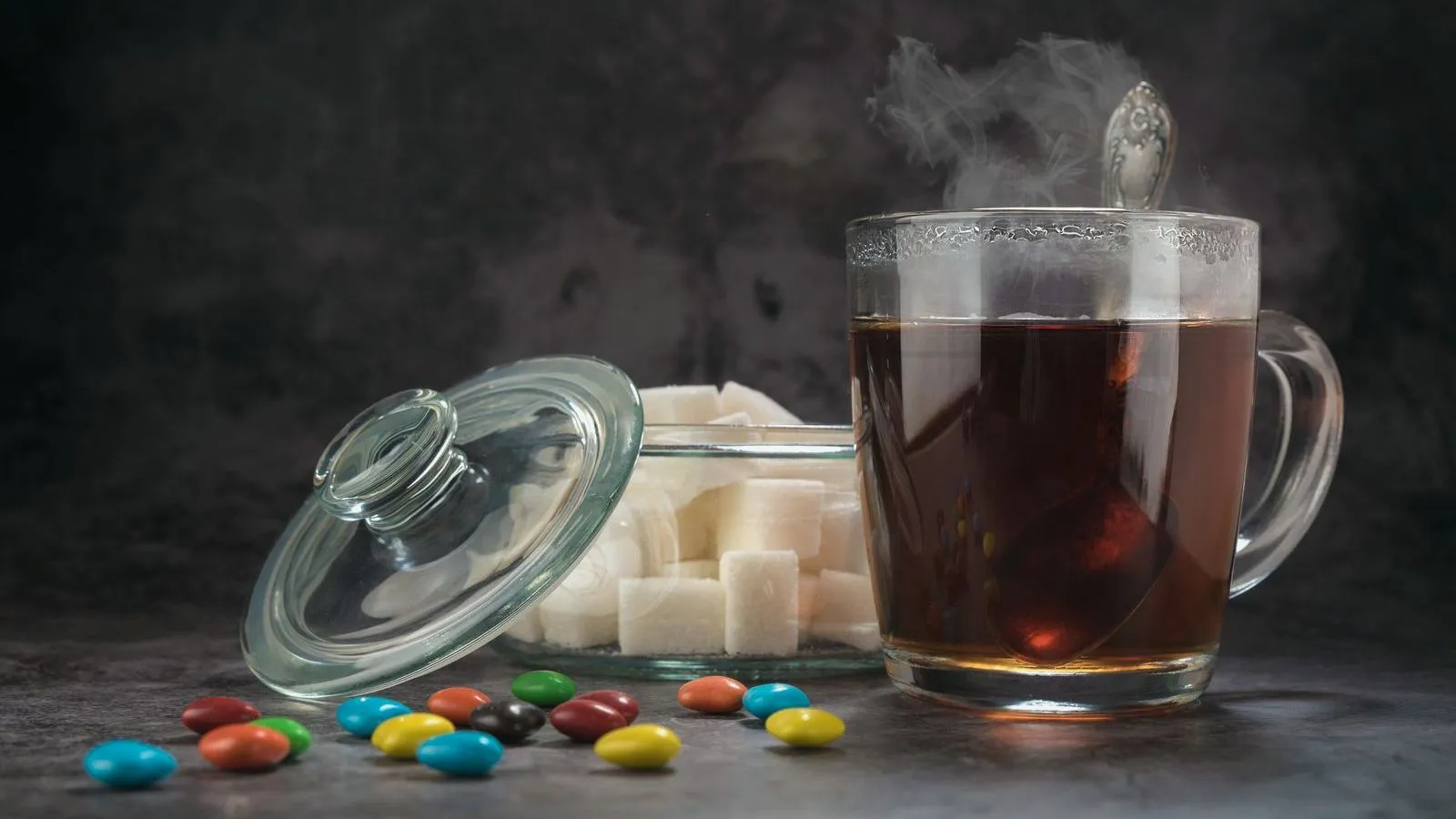
- Erythritol is sold as a sweetener and also made inside the body from glucose.
- People whose blood erythritol fell furthest were the ones whose insulin resistance improved most.
- The link was still visible two years later.
- Two related sugar alcohols behaved the same way; two others did not.
- This tracks a marker in the blood, and cannot say whether eating the sweetener matters.
Erythritol has spent a decade being the reassuring one. It is on the label of the sugar-free chocolate and the protein bar, it does not spike blood sugar, and it has almost no calories.
What most people do not know is that your body makes it anyway. Erythritol is a non-nutritive sweetener that is also endogenously produced from glucose, which means a blood test for it measures two different things at once: what you swallowed, and what your own metabolism assembled.
Writing in the International Journal of Obesity, researchers used that second fact. In 802 adults with overweight or obesity who participated in the POUNDS Lost trial, they tracked plasma erythritol as people dieted, and found that plasma erythritol levels were positively related to HOMA-IR, fasting insulin, and glycemic markers at baseline.
The people whose erythritol fell furthest were the people whose insulin resistance improved most.
Why an internally produced sweetener is interesting
Most nutrition research asks what happens when people eat a thing. This asks something stranger.
Glucose can be shunted down a side route called the pentose phosphate pathway, and erythritol comes out of the end of it. That route runs harder when cells are handling more glucose than they comfortably can, which is roughly what insulin resistance is.
So a raised blood erythritol level may be less a record of the diet drink and more a readout of how the body is coping. That reframes the molecule from an additive into a possible marker.
What actually moved
The associations ran in the same direction at every timepoint the study looked at.
Greater declines in plasma erythritol in response to the interventions were associated with greater reductions in HOMA-IR and fasting insulin at six months. HOMA-IR is a calculation that combines fasting glucose and fasting insulin into one estimate of insulin resistance, and it shifts long before anyone is diagnosed with anything.
The two-year result is the more striking one. Every 1 SD reduction in plasma erythritol during the initial 6-month period was related to long-term decreases in HOMA-IR, along with small falls in fasting glucose and in the long-term blood sugar marker.
Blood glucose, or blood sugar, is the main sugar found in your blood, and when it goes up it signals your pancreas to release insulin. A marker that falls alongside that whole system settling down is doing something useful.
The part that does not move together
Not every sugar alcohol behaved the same way, and that is the detail that makes the finding harder to dismiss.
Similar associations were found for changes in arabitol/xylitol, but not for mannitol/sorbitol. If the result were an artifact of dieting in general, or of losing weight, you would expect every polyol in the blood to drift down together and every association to look alike.
They did not. Two of the three tracked insulin resistance and one did not, which points at something specific to how those particular molecules are produced rather than at a general effect of eating less.
What this study cannot tell you
It cannot tell you whether erythritol in food is doing anything, and that is the sentence most likely to be lost in the retelling.
Nobody in POUNDS Lost was assigned to consume erythritol or to avoid it. Intake was not measured. The exposure is a blood concentration produced by an unknown mix of diet and internal metabolism, and a weight-loss diet changes both at once.
The direction of the arrow is also unsettled. Insulin resistance could be driving erythritol production, which would make the molecule a symptom rather than a cause, and the study design cannot separate those. The authors keep to the careful version: declines in plasma erythritol may be related to long-term improvements in insulin sensitivity and glycemic status.
Where this sits alongside the other erythritol news
There is a separate line of research, not part of this study, that has linked higher blood erythritol to platelet reactivity and clotting. It has generated headlines and it is not settled either.
What both lines share is the same awkward fact underneath: because the body makes this compound, a raised level in someone’s blood is not proof that they have been drinking diet soda. Any study that treats plasma erythritol as a measure of consumption is measuring something else as well.
That is a reason for caution about strong claims in either direction, including the reassuring ones.
What a person should take from it
Nothing about the sweetener aisle, and something about the diet.
Good nutrition is about healthy eating, which means regularly choosing healthy foods and beverages, and the intervention that moved the marker here was weight loss achieved through diet, not the removal of any particular additive.
The genuinely new idea is that a compound most people think of as an inert sugar substitute may be a window into how well the body is handling glucose. If that holds up, erythritol becomes something to measure rather than something to avoid, which is a different conversation from the one currently happening on the label.
People also ask
What did the study find?
Greater declines in plasma erythritol in response to the interventions were associated with greater reductions in HOMA-IR (p<0.001) and fasting insulin (p<0.001) at 6 months. Every 1 SD reduction in plasma erythritol during the initial 6-month period was related to long-term (2-year) decreases in log-transformed HOMA-IR (beta -0.07, p=0.008), fasting glucose (-1.0 mg/dL, p=0.025) and HbA1c (-0.05%, p=0.019).
Isn't erythritol just a sweetener?
It is sold as one, and it is also made inside the body from glucose. That second fact is what this study turns on: plasma erythritol partly reflects your own metabolism rather than what you ate, which is why a weight-loss diet can lower it.
So does eating erythritol raise the level?
It can, but this study did not measure intake and cannot separate eaten erythritol from made erythritol. Nobody in the trial was assigned to consume or avoid it. The exposure here is a blood level, not a food choice.
What is HOMA-IR?
A calculation combining fasting glucose and fasting insulin into a single estimate of how resistant the body has become to its own insulin. It is a research measure rather than a clinical test, and it moves before diabetes appears.
Which other sugar alcohols behaved this way?
Similar associations were found for changes in arabitol/xylitol, but not for mannitol/sorbitol. A finding that applies to some polyols and not others is more credible than one that moves all of them together.
Does this mean erythritol causes insulin resistance?
No. This is an observational analysis inside a randomized trial, and the arrow could point either way: erythritol production may rise because of insulin resistance rather than causing it. The authors describe the associations, not a mechanism.
Should anyone stop using erythritol?
Not on this evidence, which is not about consumption at all. Separate research on erythritol and blood clotting has raised different questions worth watching. This is general information rather than medical advice.