News · Nutrition & Diet
A bacterium from kimchi stuck to nanoplastics and doubled how much mice passed in their droppings
Nanoplastics are turning up in food, water and human organs, and nobody has a way to get them out. A strain of lactic acid bacteria from kimchi bound them in gut-like conditions and sent more of them out of mice.
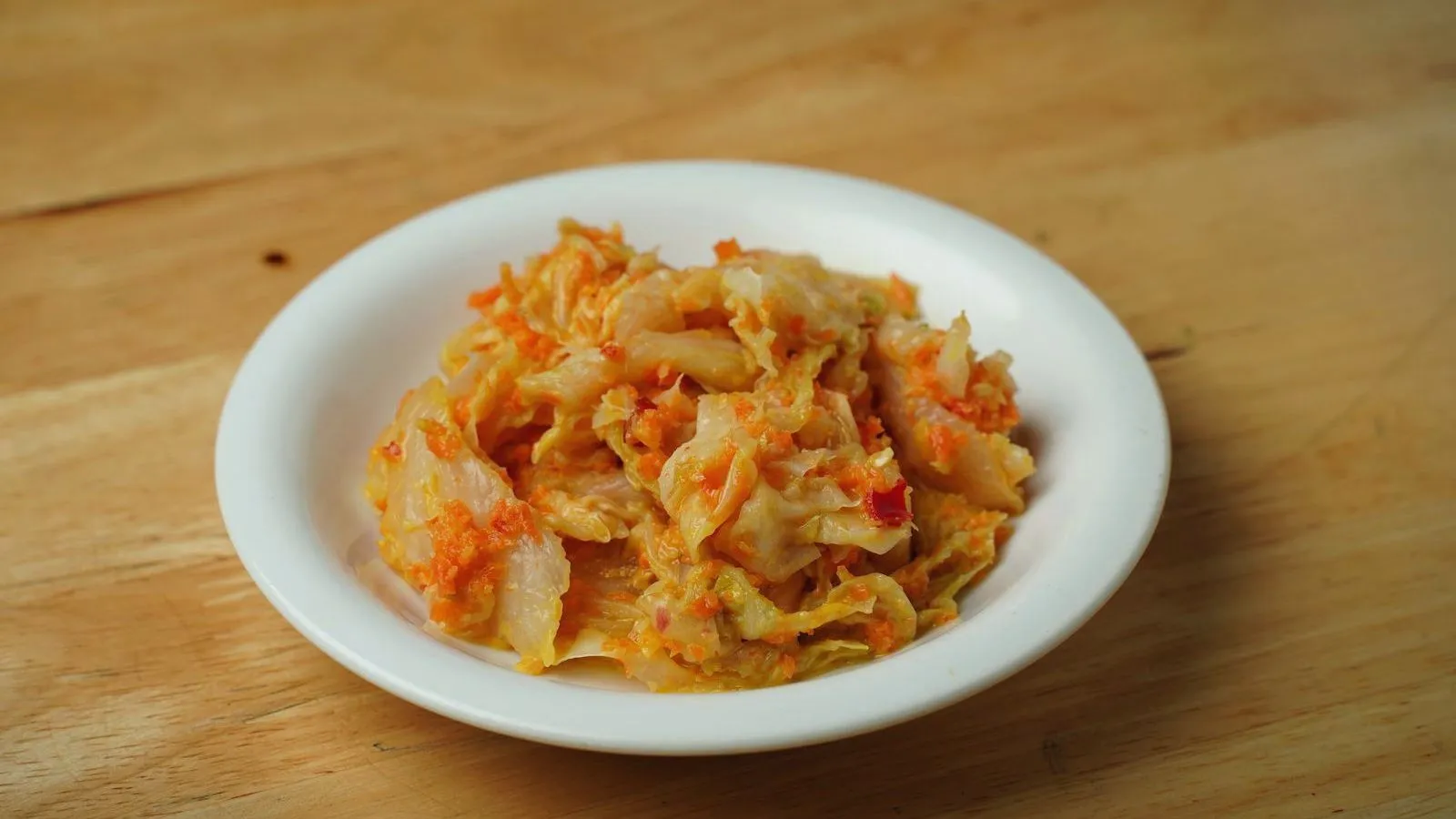
- The animal work was done in germ-free mice; nothing here has been tested in people.
- A kimchi bacterium, Leuconostoc mesenteroides CBA3656, bound plastic particles onto its surface.
- It held onto them in simulated intestinal fluid, where a comparison strain largely failed.
- Mice given the bacterium passed more than twice as much plastic in their feces.
- Passing more plastic is not the same as being healthier, which was not measured.
Plastic has been found in bottled water, table salt, placentas and arteries, and the smallest fragments are the ones researchers worry about most. Nanoplastics are under a micrometer across, small enough to slip through the gut wall, and there is no accepted way to get them out of a body once they are in. A study in germ-free mice tested an unlikely candidate for the job: a bacterium from kimchi.
The strain bound plastic particles to its surface, kept hold of them in conditions mimicking the human intestine, and more than doubled the amount of plastic the mice passed in their droppings.
Why are nanoplastics a problem?
Nanoplastics are measured in fractions of a micrometer, so small that the usual barriers do not stop them. According to the World Institute of Kimchi, the Korean government-funded institute behind the work, these particles can enter the human body through food and drinking water and, because of their size, may cross the intestinal barrier and accumulate in organs such as the kidneys and brain.
What to do about that is an open question. As the authors of the paper put it, the situation calls for effective removal strategies applicable to both environmental and intestinal conditions. Filtering water is one approach. Getting particles out of a gut is quite another.
Why would a food bacterium bind plastic?
Bacteria are covered in molecules that grab things. The cell wall and membrane carry charged chemical groups, and plastic particles can stick to them: a process called biosorption, meaning the particle attaches to the outside of the cell rather than being eaten and broken down.
Writing in Bioresource Technology, the team tested Leuconostoc mesenteroides CBA3656, a lactic acid bacterium isolated from kimchi, against polystyrene nanoplastics. Infrared analysis pointed to specific groups in the cell wall and membrane doing the binding, and the mathematics of how the particles accumulated indicated predominantly physical adsorption rather than any chemical reaction.
How well did the kimchi strain hold on?
Under standard laboratory conditions the strain bound 87% of the plastic, similar to a reference strain at 85%, according to the institute’s announcement. That part is unremarkable; plenty of bacteria will stick to plastic in a beaker.
The interesting result came when the researchers switched to simulated human intestinal fluid, a mixture designed to reproduce the chemistry of the gut. There the reference strain’s binding collapsed to 3%, while the kimchi strain held at 57%. The paper reports that the strain worked across a wide range of concentrations, acidity from pH 3 to 9, and temperatures from 4 to 55 degrees Celsius.
That difference matters because the gut is a hostile environment. A binding agent that works in a test tube and fails in stomach acid is no use to anyone.
What happened in the mice?
The animal test used germ-free mice, raised without any gut bacteria of their own, which lets researchers see what a single introduced strain does without competition. Male and female mice were given the bacterium along with nanoplastics.
Compared with untreated animals, treated mice showed more than a twofold increase in nanoplastics detected in their feces. The straightforward reading is that plastic bound to the bacteria passed through rather than being absorbed, which is what the researchers propose.
What does the nanoplastics study not show?
Quite a lot, and the gaps are worth stating plainly. No health outcome was measured. Passing more plastic in feces is a sensible surrogate for absorbing less, but nobody demonstrated that the mice were better off, and no one has established what level of nanoplastic exposure causes harm in people.
Germ-free mice are also a long way from a human gut, which already contains hundreds of competing species. And the strain was given deliberately, in controlled amounts, alongside the plastic. The paper itself is paywalled and its limitations section was not reviewed for this article; the figures above from the institute’s announcement are its own account of the work.
So should you eat more kimchi?
Not for this reason. The study tested one named strain in a laboratory, and a jar of kimchi is not a delivery system for it. Fermented foods have their own modest evidence base for gut health, which this work neither strengthens nor weakens.
The more practical lever is exposure. MedlinePlus’s food safety guidance is about germs rather than plastics, but the general principle of paying attention to what food is stored and heated in is not a bad one. What this study really offers is a lead for researchers: if a single food-derived strain can hold plastic through the gut, there may be a useful probiotic in there somewhere. That is a long way from a product.
People also ask
What did the study find?
The food-derived bacterium Leuconostoc mesenteroides CBA3656 showed high nanoplastic biosorption across concentrations of 10 to 200 ppm, pH 3 to 9 and temperatures of 4 to 55 degrees Celsius. Under simulated intestinal fluid it outperformed other strains of the same species, and in vivo experiments showed significantly enhanced fecal excretion of nanoplastics.
What are nanoplastics?
Plastic particles smaller than one micrometer, produced as larger plastics break down. They are small enough to cross the gut wall, and reach the body through food and drinking water.
What does biosorption mean?
Particles sticking to the outside of a cell rather than being digested. Here the plastic bound to molecules in the bacterium's cell wall and membrane.
How big was the effect in mice?
Male and female germ-free mice given the bacterium passed more than twice as much nanoplastic in their feces as untreated mice, according to the institute's announcement.
Should I eat more kimchi to clear plastics?
This study does not support that. It tested one specific strain, in a dish and in germ-free mice, and eating kimchi does not reliably deliver that strain to your gut in the amounts used.
Does it matter if plastics leave in feces?
It may, but nobody has shown it. The study measured excretion, not health outcomes. This is general information rather than medical advice.
References
- Efficient biosorption of nanoplastics by food-derived lactic acid bacterium. Bioresource Technology, 2026.
- This popular fermented food may help flush nanoplastics from the body. ScienceDaily, materials provided by the World Institute of Kimchi, 2026.
- MedlinePlus. Food Safety. US National Library of Medicine.