News · Fitness & Exercise
Light weights with a blood flow cuff matched heavy lifting for strength in 45 rehab trials
A British Journal of Sports Medicine review pooled 45 trials and 1,652 people in musculoskeletal rehab. Low-load exercise with a blood flow cuff beat low-load exercise alone for strength, and drew level with heavy lifting.
- 45 randomized trials, 1,652 people with musculoskeletal conditions.
- Cuffed light exercise beat light exercise alone for strength (0.82) and disability (0.63).
- Against heavy lifting it drew: no clear difference in strength (0.08).
- Pain differences favored the cuff but were small and probably not meaningful.
- Certainty was low for the winning comparison, and prediction intervals were wide.
To build strength you have to lift heavy. That rule has governed rehabilitation for decades, and it is a problem for exactly the people who need strength most: the knee six weeks out of surgery, the arthritic hip, the shoulder that will not tolerate load.
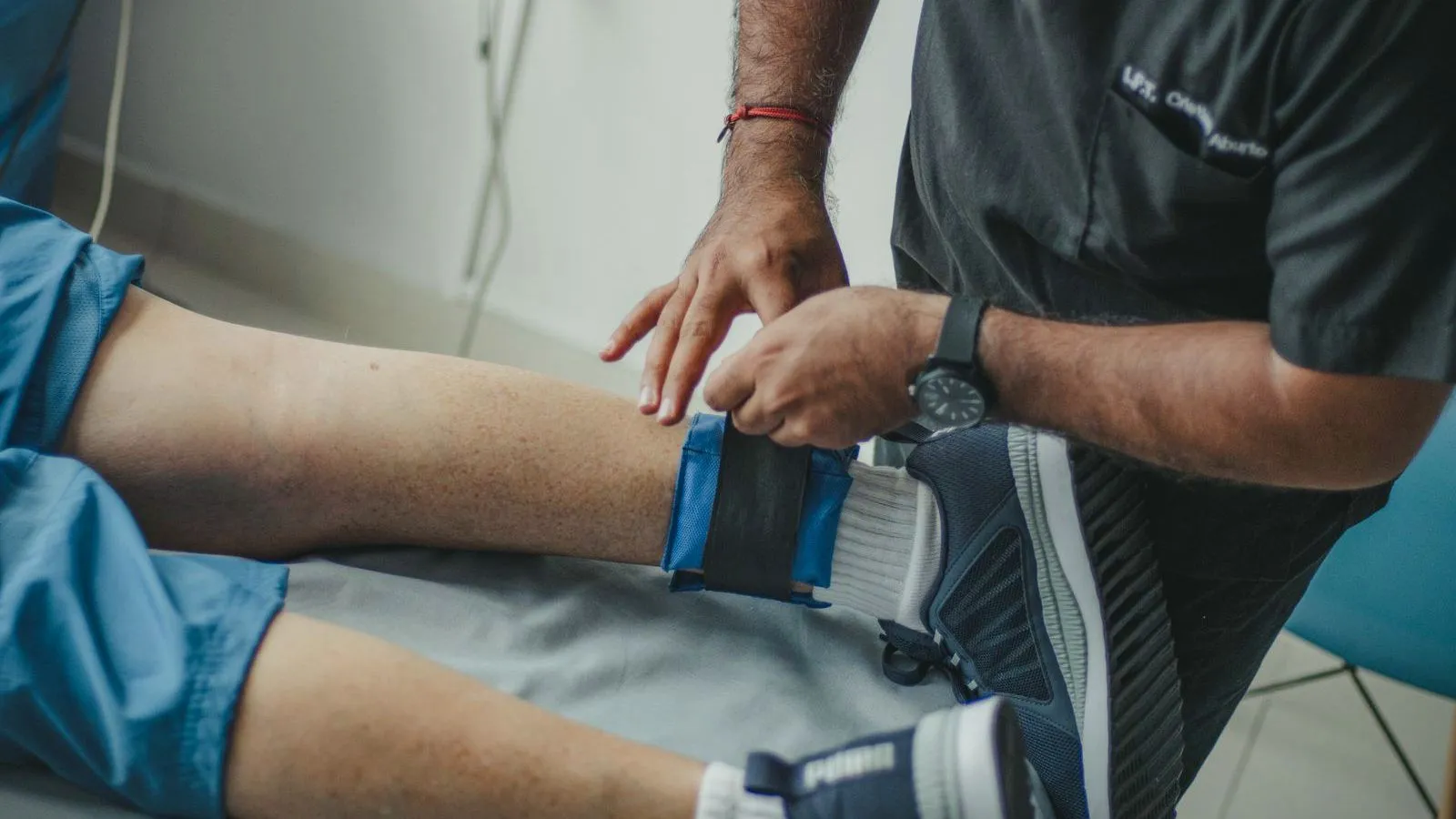
Blood flow restriction training is the workaround. A pressurized cuff goes round the top of the limb, restricting flow out of the working muscle, and the person lifts something light. The muscle behaves, metabolically, as though the weight were far heavier.
Pooling 45 randomized trials and 1,652 people, a review in the British Journal of Sports Medicine finds the trick holds up. Against light exercise alone, the cuff won clearly. Against heavy lifting, it drew.
What a draw with heavy lifting is worth
Moderate-certainty evidence showed no clear difference between cuffed low-load exercise and high-load exercise for muscle strength, at a standardized difference of 0.08, which is as close to nothing as these analyses get.
For most comparisons, a null result is the boring answer. Here it is the entire point. If light lifting with a cuff produces the same strength gain as heavy lifting, then everyone who cannot lift heavy has a route to the same destination.
Against the fair comparison, light exercise without a cuff, the gap was substantial. Low-certainty evidence indicated the cuffed version was superior for muscle strength, at 0.82, and for disability, at 0.63. Disability there means the functional scores that ask whether you can climb stairs, carry shopping, sleep through the night.
Two clean findings, then: better than the thing you would otherwise do, and no worse than the thing you cannot do.
Where the cuff evidence gets softer
The review is unusually careful about grading itself, and the grades do not all point the same way.
The two central findings do not carry equal weight. The advantage is graded low certainty. The draw is graded moderate. So the claim most likely to survive further trials is the equivalence, not the superiority.
Trial quality was middling. The team reports a mean PEDro score of 6.55, and most of the included trials were rated as ‘some concerns’ across one or more RoB 2 domains. Those are two standard scoring systems for how well a physiotherapy trial was run, and “some concerns” is the middle box.
Precision is a further issue. Prediction intervals were wide for several outcomes, meaning the next trial could land well outside the pooled estimate. The strength advantage ranges from 0.40 to 1.23, which spans moderate to very large.
Cuffs and pain, and the word unimportant
The paper reports pain differences favoring the cuff over both comparisons, and then declines to make anything of them: although pain reductions favored LLE-BFR, these effects were small and unlikely to be clinically meaningful.
A meta-analysis explicitly labeling its own significant result unimportant is worth pausing on. Statistical detectability and clinical relevance are different questions, and 45 pooled trials have enough combined participants to detect differences that no patient would notice.
Treat the strength and disability findings as the result and the pain finding as noise with a number attached.
The blood flow safety data are absent
Cuffing a limb and exercising it sounds like something that ought to be checked carefully for clots and nerve problems. The review looked, and found the literature had not.
Very-low and low-certainty evidence suggested no difference in adverse events between the cuffed and uncuffed groups, or against heavy lifting, but the authors write a qualification straight after it: adverse-event monitoring and reporting were inconsistent across trials.
That is not a finding of safety. It is a finding that trials were not consistently recording harm, which is a gap rather than an all-clear, and it is the strongest argument for keeping this technique inside a clinic where somebody sets the cuff pressure properly.
Who should ask about a cuff
Blood flow restriction is not a home experiment with a resistance band and a belt. Pressure has to be set relative to the limb’s own occlusion pressure, which requires equipment and someone trained to use it.
The people for whom this evidence matters are the ones with a reason not to lift heavy: post-surgical knees, painful arthritis, tendon problems, and older adults for whom heavy loading is unsafe or unappealing. For them the review offers something specific, which is permission to train light without accepting a lighter result.
For everyone else, the ordinary advice still applies, and it is duller. Challenge yourself by lifting slightly heavier weights, adding a few more minutes to your walk, or increasing your pace. If you can load the joint, load it. The cuff exists for when you cannot.
People also ask
What did the review find?
Low-certainty evidence indicated low-load exercise with blood flow restriction, or LLE-BFR, was superior to low-load exercise alone, or LLE, for muscle strength (standardized mean difference 0.82, 95% CI 0.40 to 1.23) and disability (SMD 0.63, 95% CI 0.36 to 0.89). Moderate-certainty evidence showed no clear difference between LLE-BFR and HLE for muscle strength (SMD 0.08, 95% CI -0.20 to 0.35).
What is blood flow restriction training?
Exercising with a pressurized cuff around the top of the limb, which partly restricts blood flow out of the working muscle. It lets people train at loads far below the usual threshold for building strength, roughly 20 to 30 percent of maximum instead of 70 or more, and still get a strength response.
How good was the evidence?
Mixed, and the paper grades it honestly. We included 45 RCTs (1652 participants), with 44 RCTs (1607 participants) contributing to meta-analyses, mean PEDro score 6.55, and most of the included trials were rated as 'some concerns' across one or more RoB 2 domains. The strength advantage over low-load exercise carries only low-certainty evidence; the draw with high-load carries moderate certainty.
Did it help pain?
Barely. Moderate- and low-certainty evidence indicated small, unimportant differences favoring LLE-BFR over LLE and HLE for pain intensity. The authors add that although pain reductions favored LLE-BFR, these effects were small and unlikely to be clinically meaningful.
Is it safe?
The data are thin rather than reassuring. Very-low and low-certainty evidence suggested no difference in adverse events between LLE-BFR and LLE or HLE; however, adverse-event monitoring and reporting were inconsistent across trials. Absence of reported harm in trials that were not consistently looking for it is a weaker claim than it sounds.
What does a 0.82 effect size mean?
It is a standardized difference of roughly four fifths of a standard deviation, conventionally read as large. The range around it runs from 0.40 to 1.23, so the true value could be anywhere from moderate to very large, and the authors note that prediction intervals were wide for several outcomes.
Who is this actually for?
People who cannot load a joint heavily: after knee surgery, with painful arthritis, or when a tendon will not tolerate the weight that normally builds strength. It requires proper cuffs and supervision to set the pressure, so it is a clinic technique rather than a home one. This is general information rather than medical advice.
References
- Do blood flow restriction exercises offer additional benefits when compared to conventional exercises in musculoskeletal rehabilitation? A systematic review and meta-analysis. British Journal of Sports Medicine, 2026.
- MedlinePlus. Exercise and Physical Fitness. US National Library of Medicine.
- World Health Organization. Physical activity fact sheet.