News · Brain & Mental Health
Therapy animals eased depression in older adults across 20 studies, but not loneliness
A review in the Journal of the American Medical Directors Association pooled 20 studies of live and robotic animals in older adults. Depression and thinking scores improved. Anxiety and loneliness did not move.
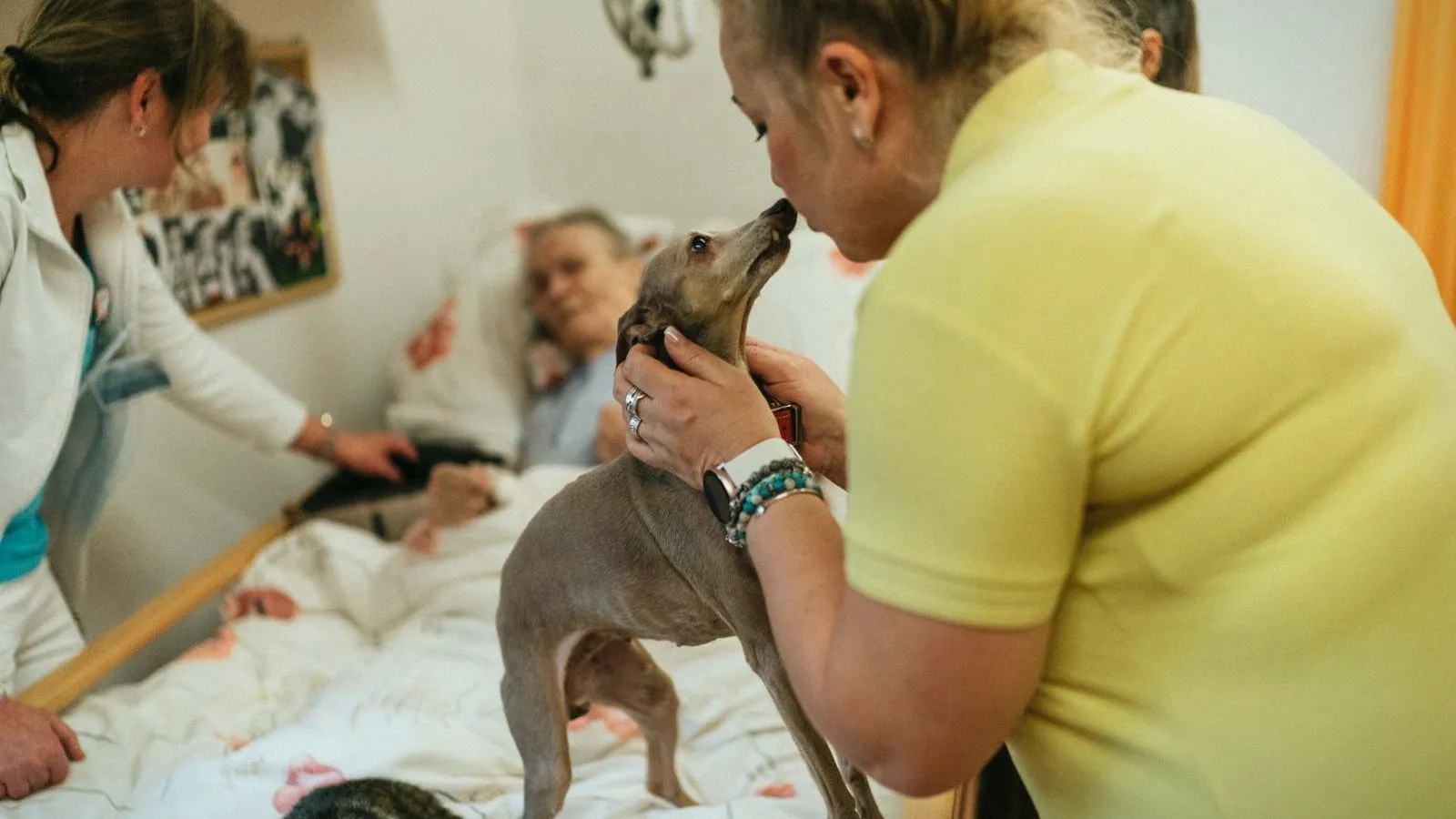
- 20 studies: 16 randomized trials and 4 quasi-experimental, searched to January 2026.
- Depressive symptoms improved by a moderate amount (SMD -0.45, 95% CI -0.68 to -0.22).
- Cognitive function improved more but far less precisely (SMD 0.72, 95% CI 0.12-1.31).
- No significant pooled effects for anxiety or loneliness.
- Certainty of evidence was low for depression and low to very low for the rest.
Ask anyone why a care home brings in a therapy dog and the answer comes back within a word or two of loneliness.
Pool 20 studies of animal-assisted interventions in older adults, as a new review in the Journal of the American Medical Directors Association does, and loneliness is the one thing that does not shift. Neither does anxiety. No significant pooled effects were identified for anxiety symptoms or loneliness.
The improvements landed elsewhere: in depressive symptoms and cognitive function in older adults.
What the review adds is the comparison. It assesses depressive symptoms, anxiety symptoms, loneliness, and cognitive function in one pool, with live and robotic animals side by side, so the four outcomes can be ranked against each other rather than read one paper at a time. The result challenges the reason these programs are usually funded, because the loneliness benefit, long assumed, is the one that fails to appear.
Two therapy-animal results, one of them solid
The depression finding is the one to keep. Pooled across the studies, the review reports a moderate effect on improving depressive symptoms, which works out at roughly half a standard deviation, and the range around it is narrow enough that the direction is not in doubt.
Depression in later life is worth this much attention because it hides in plain sight. It is more than a feeling of being sad or irritable for a few days; it’s a serious mood disorder and one of the most common mental disorders in the United States, one that can affect how you think, feel, and your everyday life. Symptoms such as losing interest in favorite activities get filed under getting older, and go untreated for years.
The cognition result looks more impressive and is worth far less. The estimate is larger, but its range stretches from an effect too small to notice up to one that would be remarkable, which is what happens when a handful of small studies measure the same thing in different ways. Take the direction and ignore the size.
Where a robotic seal comes into it
Half the interest in this field now sits with animals that are not alive. Robotic pets, built to respond to touch and voice, have spread through dementia care because they never bite, never need walking and cannot carry infection. Putting both kinds in the same analysis is what makes this review useful. Larger effects on depressive symptoms were observed in interventions involving live animals, quasi-experimental study designs, and intervention durations of 6 to 12 weeks.
Read that list carefully, because two of its three items are about study design rather than about animals. Quasi-experimental means participants were not randomly assigned, and weaker designs reliably produce larger effects. So part of the live-animal advantage may be an artifact of which studies happened to use live animals. The honest summary is that live animals looked better, and the comparison was not clean.
Why the loneliness null is the interesting result
A null finding is usually the least interesting thing in a paper. This one inverts the field’s own assumption, so it earns a paragraph. Loneliness is a social state, not a mood. It is about the gap between the relationships you have and the ones you want, and a dog visiting on Tuesdays does not close that gap, however much you enjoy the hour. Depression is a condition an intervention can treat. Loneliness is a circumstance, and treating it takes changing the circumstance.
That distinction has practical weight for anyone commissioning these programs. If the goal on the funding form is reducing loneliness, this evidence does not support the spend. If it is mood, it does, weakly.
What low certainty means for animal therapy
The authors are unusually blunt about their own evidence. The certainty of evidence was rated as low for depressive symptoms, very low for anxiety symptoms, low to very low for loneliness, and low to very low for cognitive function. Nothing in this review reached moderate.
Certainty grades answer a different question from the effect size. The effect size asks how big; certainty asks how much a future trial might change the answer. Low means a well-run study could move these numbers substantially, and very low means the current estimate is close to a placeholder. Two features of this literature explain the grades. Nobody can blind a participant to whether a dog is in the room, and the outcomes are almost all self-reported questionnaires, so expectation has a clear path into the result. The studies are also small, which is why the intervals are wide.
What a family or a care home should do
For a person in later life with low mood, this is a reason to try something that costs little and carries almost no risk. Twenty studies now point the same way on depression, and the authors write that the findings “support AAIs as a promising complementary approach for depression and cognitive support in later life”. Complementary there means alongside proper treatment, not in place of it.
The cognitive claim deserves less weight than its number suggests. Older adults may worry about their memory and other thinking abilities, such as taking longer to learn something new, and these changes are usually signs of mild forgetfulness that are often a normal part of aging. A therapy animal is not a treatment for memory loss, and the wide range around this estimate is the reason to say so plainly.
What the review will not tell you is which animal, how often, or for how long. Twenty small studies cannot answer that, and the authors say the field needs larger, well-designed multicenter trials before it can.
People also ask
What did the review find?
AAIs have a moderate and statistically significant effect, meaning one that cleared the statistical threshold, on improving depressive symptoms (SMD, -0.45; 95% CI, -0.68 to -0.22; Z = 3.90; P < .001) and cognitive function (SMD, 0.72; 95% CI, 0.12-1.31; Z = 2.36; P = .018) in older adults, compared with the control group. No significant pooled effects were identified for anxiety symptoms or loneliness.
Why is the cognition result the weaker one despite the bigger number?
Because of its range. The effect on cognitive function is 0.72 with a 95% confidence interval running from 0.12 to 1.31, so the true value could be anything from barely detectable to very large. The depression estimate, at -0.45 with an interval of -0.68 to -0.22, is smaller but far better pinned down.
Did live animals beat robotic ones?
For depression, yes. Larger effects on depressive symptoms were observed in interventions involving live animals, quasi-experimental study designs, and intervention durations of 6 to 12 weeks. Note that quasi-experimental designs are the weaker ones, so part of that difference may reflect study quality rather than the animal.
How certain is the evidence?
Not very, and the authors grade it themselves. The certainty of evidence was rated as low for depressive symptoms, very low for anxiety symptoms, low to very low for loneliness, and low to very low for cognitive function. Nothing here reached moderate certainty.
What counts as an animal-assisted intervention?
A structured program built around contact with an animal, usually a dog, sometimes a cat, horse or bird, and increasingly a robotic substitute such as a seal or cat that responds to touch and sound. It is distinct from simply owning a pet, which this review did not study.
Why does depression matter here specifically?
Depression is more than a feeling of being sad or irritable for a few days. It's a serious mood disorder, and one of the most common mental disorders in the United States, that can affect how you think, feel, and your everyday life. In older adults it is frequently missed, partly because symptoms such as losing interest in favorite activities get read as normal aging.
Should a care home start a therapy dog program?
The evidence supports trying it for mood, with realistic expectations. The authors describe AAIs as a promising complementary approach for depression and cognitive support in later life, while underscoring the need for larger, well-designed multicenter trials. Complementary means alongside existing treatment rather than instead of it. Allergies, infection control and fear of dogs all need handling. This is general information rather than medical advice.
References
- Animal-Assisted Interventions Involving Live and Robotic Animals for Depression, Anxiety, Loneliness, and Cognitive Function in Older Adults: A Systematic Review and Meta-Analysis. Journal of the American Medical Directors Association, 2026.
- MedlinePlus. Depression. US National Library of Medicine.
- National Institute on Aging. Memory Problems, Forgetfulness, and Aging. US National Institutes of Health.