News · Brain & Mental Health
Open Dialogue did not delay relapse in its first trial, though fewer people were admitted to hospital
In 494 adults in England, the family-and-network approach made no difference to relapse over two years. Those offered it were less often admitted to hospital and rated their care higher, results that one outside expert called exploratory.
- A trial in England assigned 494 adults in a mental health crisis to Open Dialogue or to usual care.
- Time to a first relapse over two years did not differ between the two groups.
- People offered Open Dialogue were less often admitted to hospital and rated their recovery and care higher.
- The social networks the approach is meant to strengthen did not measurably change.
- Staff and patients knew who was getting which care, and the favorable results were secondary measures.
Open Dialogue has attracted wide interest in mental health care. Born in northern Finland, it brings a person in crisis together with family and friends and keeps the same small team with them for as long as care lasts. Its supporters point to good long-term outcomes in the region where it began. Until now it had never been put through a randomized trial.
The first one, run in England and published in The Lancet Psychiatry in August, gives a split verdict. On the measure the trial was built to test, how long people stayed well before relapsing, Open Dialogue made no difference. On several other measures, including hospital admissions and how people rated their own recovery, it came out ahead. Independent psychiatrists who commented on the paper said the second set of results needs careful handling.
What Open Dialogue is
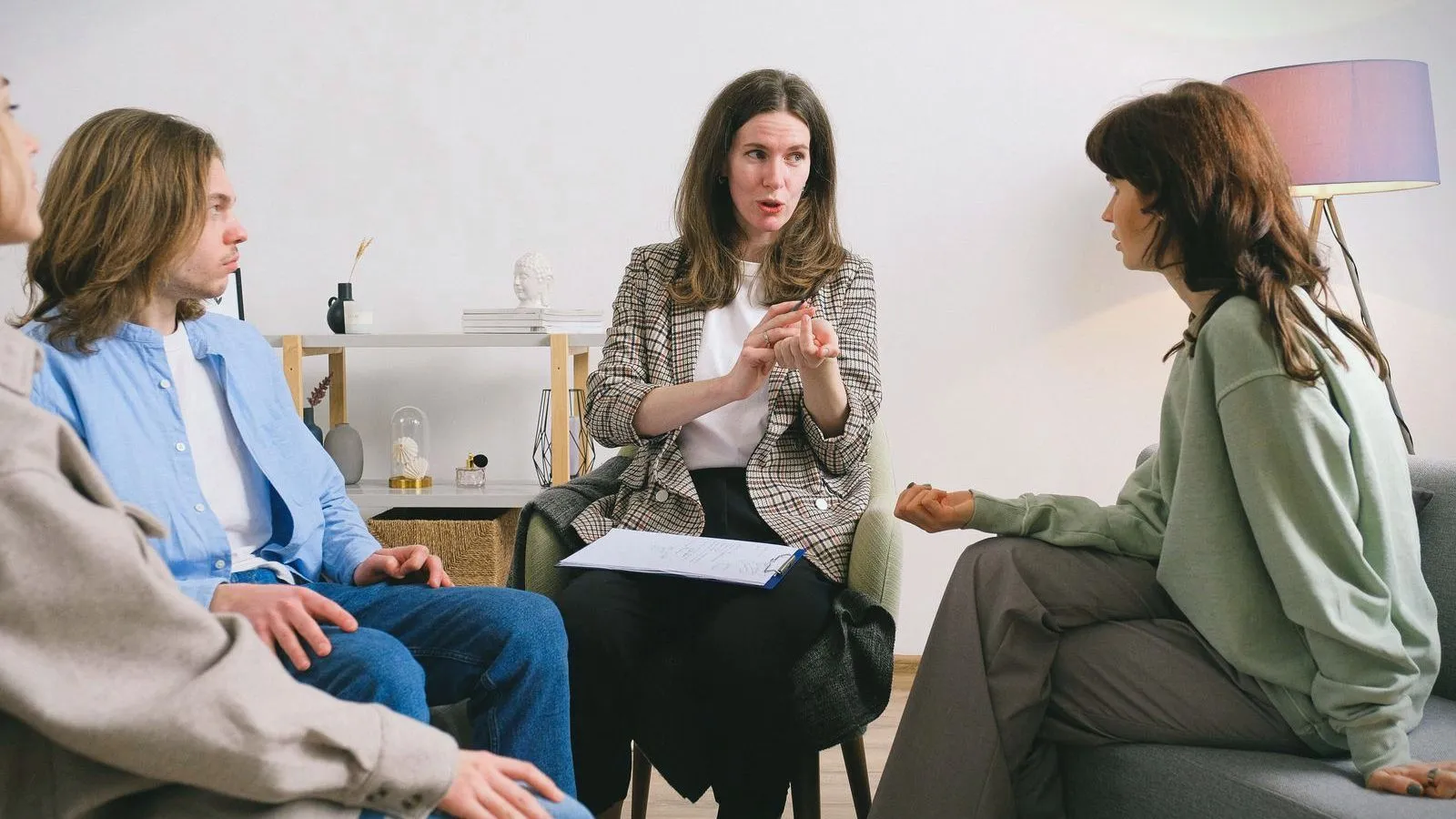
The approach is both a kind of meeting and a way of arranging services. Its center is the network meeting. The trial report describes network meetings with the service user, members of their social network, and usually two practitioners who support the network throughout the duration of care. Plans about medication, therapy and practical help are talked through in the room, with everyone present.
The university that led the trial gives the background. Developed in Finland in the 1980s, it is already in use in some NHS trusts, and interest abroad has grown faster than the evidence. A review published in 2018, whose authors included the new trial’s lead investigator, examined 23 earlier studies. It concluded that no strong conclusions can be drawn about efficacy, and it pointed out the awkward position this created, since the approach has already been adopted by many acute and community mental health services.
How the Open Dialogue trial was run
The study, a trial called ODDESSI, tested the approach for adults presenting in crisis to community mental health services in England. A crisis was defined in advance. In the protocol’s words, a mental health crisis in this study is defined as a mental health emergency, requiring an urgent response arising from a high risk of harm to self or others or a rapid increase in symptoms of psychosis or severe mood disorder.
It took place in five National Health Service trusts in London and the South of England. The unit of randomization was the neighborhood, not the person. Groups of family doctor practices were assigned at random to have their patients offered Open Dialogue or usual care, a design called cluster randomization. Usual care meant the standard arrangement in England, in which a person may pass between separate crisis, inpatient and community teams.
Between June 2019 and December 2021, 494 people agreed to take part. They provided consent for study inclusion (223 in the treatment as usual group and 271 in the Open Dialogue group). Their average age was 38. The protocol shows that the plan had been for more: when the trial was registered, the target was 570.
The main question was about staying well. The primary outcome was time (days) to first relapse following initial recovery from the index crisis, counted over two years. The index crisis is the one that brought the person into the study. Other outcomes, such as hospital admissions, quality of life and satisfaction, were secondary.
No difference in relapse after a crisis
Most participants recovered from the crisis that brought them in: 174 (78%) in the treatment as usual group and 225 (83%) in the Open Dialogue group recovered and had data enabling relapse determination.
Among them, relapse came no later with Open Dialogue. The estimated rate of relapse was 5% lower than with usual care, with a plausible range running from 33% lower to 32% higher. A range that wide, spread evenly around zero, shows no sign of an effect, though it cannot exclude a moderate one in either direction. The authors state it without qualification: Open Dialogue did not reduce time to first relapse compared with treatment as usual.
Stephen Pilling of University College London, who led the trial, said the same in the university’s announcement. The team, Pilling said, “did not find any difference in time to relapse, an important measure of mental health treatment efficacy”.
Fewer hospital admissions and better-rated care
The secondary results pointed the other way. Open Dialogue was associated with lower probabilities of psychiatric inpatient admission and re-referral to crisis care or secondary mental health services. The university put a size on the first of those. People offered Open Dialogue had more than three times higher odds of never being admitted to psychiatric inpatient hospital care during the two years.
Participants also rated things better. The paper reports improvements in self-rated recovery, health-related quality of life, and satisfaction with services.
Safety records favored the new approach in raw numbers. There were 386 serious adverse events (281 in the treatment as usual group and 105 in the Open Dialogue group), and nearly all were judged to have nothing to do with the care provided: 376 (97%) were deemed to be unrelated to the intervention.
One result did not move. The approach is designed to strengthen a person’s social network, and the protocol named two potential mediators of effect: shared decision-making and social network quality and size. A mediator is the route by which a treatment is thought to work. The quality and size of participants’ networks showed no measurable difference between the groups.
Russell Razzaque, a co-author and a consultant psychiatrist at an NHS trust in north-east London, read the results as support for the approach. In the trial, Razzaque said, “people report better recovery, better quality of life and better experiences of care, while at the same time making far less use of inpatient or crisis services”.
Why outside experts read the Open Dialogue trial cautiously
Two psychiatrists not involved in the study gave assessments to the Science Media Centre, and both were reserved.
Sameer Jauhar of Imperial College London started with the main result. The pattern of fewer admissions and better experience was of interest, Jauhar said, but “it does not establish that Open Dialogue changes the underlying course of illness in the way some of its advocates have suggested”.
Jauhar then set out why the secondary results are hard to take at face value.
The first reason is that nothing was hidden from those making the judgments. In Jauhar’s words, “neither clinicians nor participants were masked to treatment allocation”. A clinician deciding whether to admit someone knew which service that person belonged to. A participant rating their satisfaction knew which care they had received.
The second is timing. Jauhar noted that “the decrease in hospital admissions was pronounced in the first 14 days, suggesting that the triage process (gatekeeping), as opposed to any effects of therapy, may drive this finding”. Triage here means the decision at the door about who is admitted.
The third is the missing mechanism. Open Dialogue is supposed to work through a person’s social network, and the network measures did not change.
The fourth is who took part. “Fewer than 30% of participants had a diagnosis of psychosis or bipolar disorder,” Jauhar said, so the trial says little about the most severe illness, which is where the Finnish claims began.
The fifth is the number of tests. Jauhar noted that the authors “report secondary-outcome results without adjustment for multiple comparisons”. When many measures are tested, some will favor a treatment by chance, and Jauhar judged that the secondary results could be called exploratory at best. On re-referral, Jauhar added that the result “is difficult to separate from the design of the service itself”. The point was that a service built to keep people with one team gives them a route back into care that may not be counted as a new referral.
Jauhar did not dismiss the approach. “This does not mean Open Dialogue has no value,” Jauhar said, observing that continuity and quick access to a familiar team are good things in any service. “They were once a routine part of what community mental health teams delivered, before years of underfunding eroded the capacity to provide them.” Jauhar has declared personal fees from several pharmaceutical companies.
Richard Morriss of the University of Nottingham, who declared no interests, focused on design. “This trial comparing Open Dialogue versus usual care is difficult to interpret,” Morriss said. Among the reasons Morriss gave was that both kinds of care ran side by side: “The same NHS Trusts operated both treatment arms and staff circulate a lot across services, so contamination is likely.” Contamination means the comparison group picking up elements of the new approach.
What earlier studies of Open Dialogue showed
The reputation of Open Dialogue rests on reports from its home region. The longest follow-up compared 108 people treated there for a first episode of psychosis with 1,763 treated elsewhere in Finland, over about 19 years. Those in the Open Dialogue region spent less time in hospital, and fewer drew disability allowances or took antipsychotic drugs. Durations of hospital treatment, disability allowances, and the need for neuroleptics remained lower throughout, neuroleptics being an older name for those drugs. The authors did not overstate it. Due to the observational nature of the study, randomized trials are still needed, they wrote.
A Danish register study of teenagers found a mixed picture that resembles the new trial in one respect. Recipients of the intervention had fewer emergency psychiatric treatments, but there was no reduction in psychiatric hospital stays. Its authors asked for the same thing: these mixed results should be tested in a randomized design.
The English trial is that test, for one version of the approach in one health system.
What the trial leaves open
Whether this was Open Dialogue at full strength. The university’s announcement says the version tested did not include family interventions, which are routinely used in Open Dialogue in Finland, and that there was less involvement of family or friends in network meetings than intended. It offers an alternative reading of the benefits, that they may have been a result of improved mental health team functioning.
Whether the pandemic distorted it. Recruitment ran from mid-2019 to late 2021, so most of it fell after the pandemic began. Morriss pointed out that the study operated much of the time during post-COVID restrictions which restricted face to face and home contact. An approach built on gathering people in a room was tested when that was often impossible.
Whether it was large enough. The trial enrolled 494 of a planned 570, and about four in five of them entered the relapse analysis.
What it costs. Two practitioners in every meeting is a heavy use of staff. The protocol set out to assess the clinical and cost-effectiveness of Open Dialogue compared to treatment as usual. The university’s announcement says the results “suggest that Open Dialogue may help to reduce NHS costs”, a suggestion that rests on the same unblinded admission results.
Registration. The trial was retrospectively registered, after recruitment had begun.
The authors do not claim more than the data allow. Further investigation is required to determine whether Open Dialogue can enhance the effectiveness and acceptability of crisis care, they write. Jauhar’s version was blunter: “Before the NHS commits substantial resources to a branded model of care, those claims need to be tested directly, with rigor.”
The trial was funded by the National Institute for Health Research, the government-funded health research body in England. What kind of care suits a person in crisis depends on their situation, which is assessed by their doctor and mental health team.
In the first randomized trial of Open Dialogue, 494 adults in a mental health crisis in England relapsed no later than with usual care, while being admitted to hospital less often and rating their care higher, secondary results that came from an unblinded comparison in which the social networks the approach is meant to strengthen did not change.
People also ask
What is Open Dialogue?
A way of organizing mental health care developed in Finland in the 1980s. The person in crisis meets regularly with family or friends and the same two practitioners, who stay involved throughout their care. Decisions are discussed openly in those meetings.
What did the trial find?
The main measure, time to a first relapse after recovering from the crisis, did not differ between Open Dialogue and usual care. Secondary measures favored Open Dialogue: fewer hospital admissions, fewer re-referrals, and better self-rated recovery, quality of life and satisfaction.
Why are the secondary results treated with caution?
Staff deciding on admissions and patients rating their care both knew which service was involved. Many secondary measures were tested, with no statistical allowance for the number of comparisons. And re-referral may partly reflect how the service is organized.
Was Open Dialogue delivered as it is in Finland?
Not entirely. The version tested did not include the family interventions routinely used there, and family and friends took part in meetings less often than intended. Much of the trial also ran while pandemic restrictions limited face-to-face contact.
What are the limits of the trial?
It recruited 494 people against a target of 570, fewer than three in ten had psychosis or bipolar disorder, and both kinds of care were run by the same NHS trusts. What care is suitable for a particular person is assessed by their doctor. This is general information rather than medical advice.
References
- Pilling, S., Craig, T., Clarke, K., et al. Open Dialogue versus treatment as usual for adults presenting in crisis to mental health services in England (the ODDESSI Trial): a multisite cluster-randomised trial. The Lancet Psychiatry, 2026.
- University College London. Community-focused mental health care cuts hospital admissions. News-Medical, 2026.
- Science Media Centre. Expert reaction to a randomised controlled trial of Open Dialogue compared to standard NHS treatment for adults in mental health crises. 2026.
- Pilling, S., Clarke, K., Parker, G., et al. Open Dialogue compared to treatment as usual for adults experiencing a mental health crisis: Protocol for the ODDESSI multi-site cluster randomised controlled trial. Contemporary Clinical Trials, 2021.
- Bergstrom, T., Seikkula, J., Alakare, B., et al. The family-oriented open dialogue approach in the treatment of first-episode psychosis: Nineteen-year outcomes. Psychiatry Research, 2018.
- Buus, N., Kragh Jacobsen, E., Bojesen, A. B., et al. The association between Open Dialogue to young Danes in acute psychiatric crisis and their use of health care and social services: A retrospective register-based cohort study. International Journal of Nursing Studies, 2019.
- Freeman, A. M., Tribe, R. H., Stott, J. C. H., Pilling, S. Open Dialogue: A Review of the Evidence. Psychiatric Services, 2018.