News · Brain & Mental Health
White matter tracts that span the brain's hierarchy tracked the widest range of thinking skills
Researchers pooled brain scans from 2,880 people aged 5 to 37. The bundles that climb from simple sensory regions to complex association regions served the broadest set of mental functions.
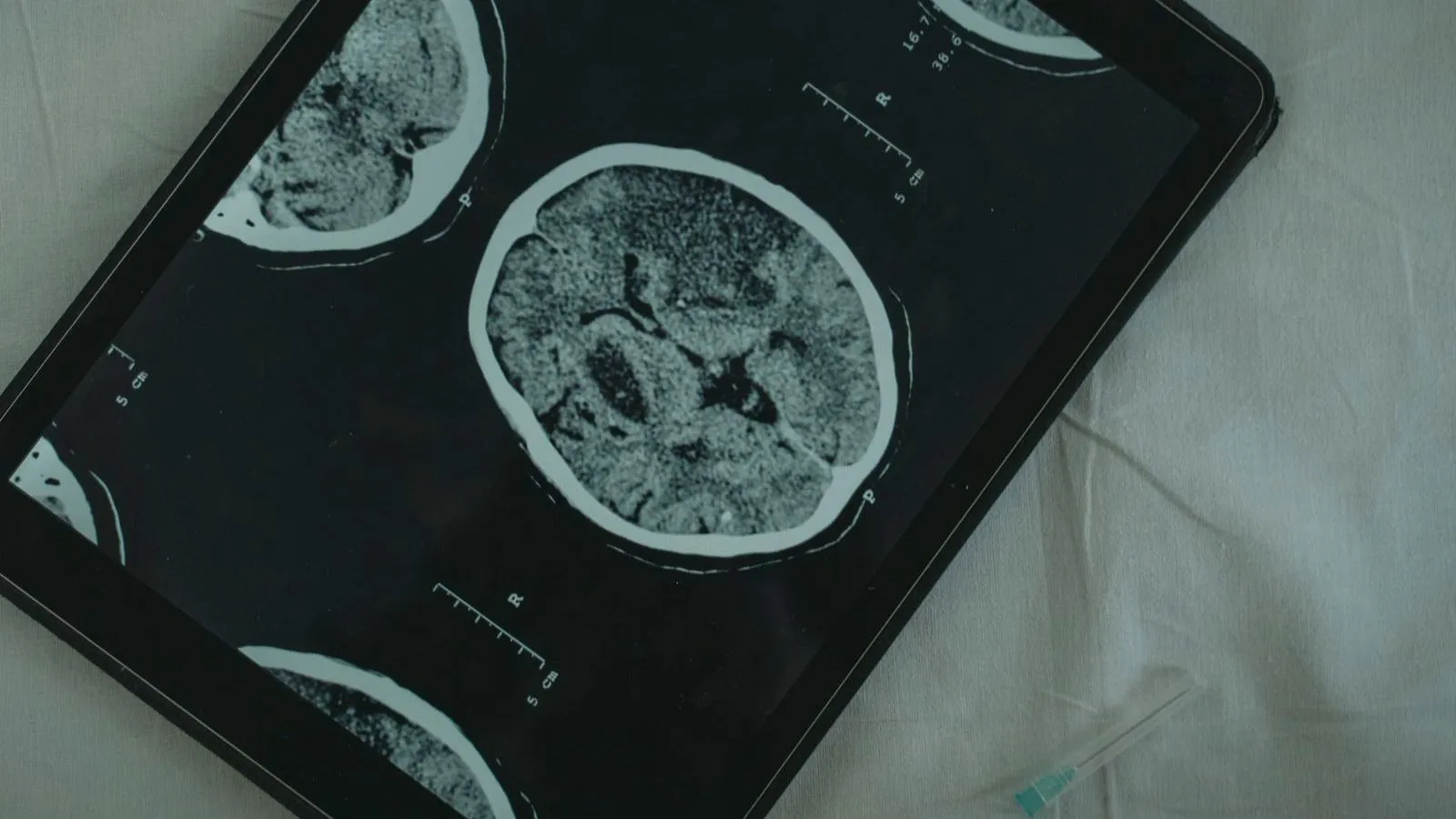
- An analysis of existing brain scans from 2,880 people aged 5 to 37, not a study of patients.
- The cortex runs on a gradient from simple sensory regions to complex association regions.
- Tracts were sorted by where they sit on that gradient rather than by their anatomy.
- Bundles that cross the gradient linked regions with the most varied mental functions.
- It is a way of describing brains, not a test or a treatment for anyone.
Neuroanatomy named its parts the way early explorers named rivers: by where they ran. The great bundles of wiring inside a brain have been sorted for a century into association tracts, which connect regions within a hemisphere, and projection tracts, which run down and out. It is a description of geography, and it says almost nothing about what any bundle is for.
A team working with brain scans from 2,880 people has tried a different filing system. Sort the wiring not by where it runs, but by what kind of cortex sits at each end, and the bundles start to line up with what people can do.
What is white matter, and what do tracts connect?
Gray matter is where the work happens; white matter is how the results get anywhere else. Many of these nerve fibers are surrounded by a type of sheath or covering called myelin, which is what makes the tissue look pale. Gray matter gets its own name the same way: it contains the cell bodies of neurons, which give gray matter its color.
Those fibers are gathered into tracts, cables of many thousands of axons running between regions. A brain has a few dozen major ones, and every anatomy student learns their names and routes.
How the brain’s cortex is organized from simple to complex
The reframing turns on a pattern in the cortex itself, described by the researchers as the sensorimotor-to-association axis. Joelle Bagautdinova, the paper’s first author, described the two ends: “At one end are regions involved in relatively basic functions such as movement and sensation; at the other are association regions involved in more complex processes such as memory, decision-making and executive function.”
This axis is not a metaphor. Gene expression, myelination, neurotransmitter systems and the timing of development all vary along it, which is why it has become one of the organizing ideas in the field. What nobody had done was ask where the wiring fits.
“We wondered whether looking at white matter through the lens of cortical organization could give us a more informative way to describe these tracts,” Bagautdinova said.
What the tracts that span the hierarchy do
Some bundles connect two regions at similar points on the gradient. Others start near the sensory end and finish deep in association territory, crossing most of the range in one hop. That distinction turned out to matter.
Writing in Nature Human Behaviour, the team reports that white matter tracts are differentially positioned in the cortical hierarchy to support specific cognitive functions, and that tracts spanning the hierarchy connect regions with greater cognitive diversity. A bundle that stays at one level links places doing similar work; a bundle that crosses levels links places doing different work, and is involved in a wider spread of mental functions.
The biology follows the same split. Tracts situated within the same hierarchical level connect biologically similar regions, while those crossing the hierarchy bridge distinct biological milieux. In other words, a long-range crossing tract is not just connecting two distant addresses; it is connecting two different kinds of neighborhood.
Why a new filing system for brain wiring is useful
Because the old one cannot answer the questions being asked of it. Imaging studies routinely report that some tract differs between groups, or changes with age, or tracks with a test score. Interpreting that difference requires knowing what the tract is for, and “it runs front to back within the hemisphere” does not help.
The team’s framework also picked up developmental variation in tract microstructure and individual differences in cognition, which is what you would want if the position of a tract on the gradient is really telling you something about its job. The authors present this as a way to move beyond conventional categories of association or projection tracts.
What 2,880 brain scans cannot show
Nothing here follows a person over time. The analysis pools three existing datasets spanning ages 5 to 37, so the developmental pattern is assembled from different people at different ages rather than watched in the same brain.
Diffusion imaging, the method behind tract mapping, is also an inference rather than a photograph. It tracks the movement of water to estimate where fiber bundles run, and it struggles precisely where fibers cross, which is a known limitation of every study built on it.
The cognitive side is coarser than the anatomy. Linking a tract to a broad range of mental functions is a statement about test batteries, not about what a person does on a Tuesday, and the sample stops at 37, so nothing here speaks to the aging brain.
What this changes about reading a brain scan
Not the scan, the sentence written underneath it. This is a framework paper, and its value is in what it lets other researchers say: instead of noting that a named bundle looks different in a group, they can say where that bundle sits in the cortex’s own organization and what kind of regions it bridges.
For anyone outside the field there is nothing to do and nothing to worry about. What is quietly pleasing is the shape of the result. A century of naming things by their route produced a map of the brain’s roads; this is closer to a map of what the roads are for, which is the version you actually want when you are trying to work out why traffic behaves the way it does.
People also ask
What did the study find?
White matter tracts are differentially positioned in the cortical hierarchy to support specific cognitive functions, and tracts spanning the hierarchy connect regions with greater cognitive diversity. Tracts situated within the same hierarchical level connect biologically similar regions, while those crossing the hierarchy bridge distinct biological milieux.
What is white matter?
The wiring of the brain. Nerve fibers wrapped in a fatty sheath called myelin, bundled into tracts that carry signals between regions. It is called white matter because the myelin makes it look pale next to the gray matter where the cell bodies sit.
What is the sensorimotor-to-association axis?
A gradient across the cortex. At one end sit regions handling movement and the senses; at the other sit association regions involved in memory, decision-making and executive function. Most of the cortex's other properties, from gene expression to myelination, vary along the same line.
Whose brains were scanned?
Nobody new. The team combined three existing datasets: 1,145 participants aged 8 to 23, 638 aged 5 to 22 and 1,097 young adults aged 22 to 37.
Why does it matter how tracts are classified?
The textbook names tracts by where they run in the skull. Sorting them by what kind of cortex they connect groups them by what they do, which is the more useful description if the question is about cognition.
Does this help anyone with a brain condition?
Not yet. It is a framework for interpreting differences in white matter rather than a diagnostic tool. This is general information rather than medical advice.