News · Longevity & Aging
A blood metabolite clock tracked death risk and frailty
GeroScience researchers built an aging clock from 3,686 blood samples across UK and Irish cohorts. Five years of extra metabolic age came with 43% higher death risk.
- 3,686 plasma samples from 2,295 people aged 20 to 89 across UK and Irish cohorts.
- The clock predicted calendar age closely in held-out samples (r=0.92).
- About five years of extra metabolic age came with 43% higher death risk and 10% higher frailty risk.
- Six metabolites did most of the work, including bile acid markers and the antioxidant zeta-carotene.
- Correlational, and two European cohorts only, so transfer to other populations is untested.
Aging clocks mostly read DNA. A study in GeroScience built one from something that changes far faster: the small molecules floating in blood after the body has finished metabolizing.
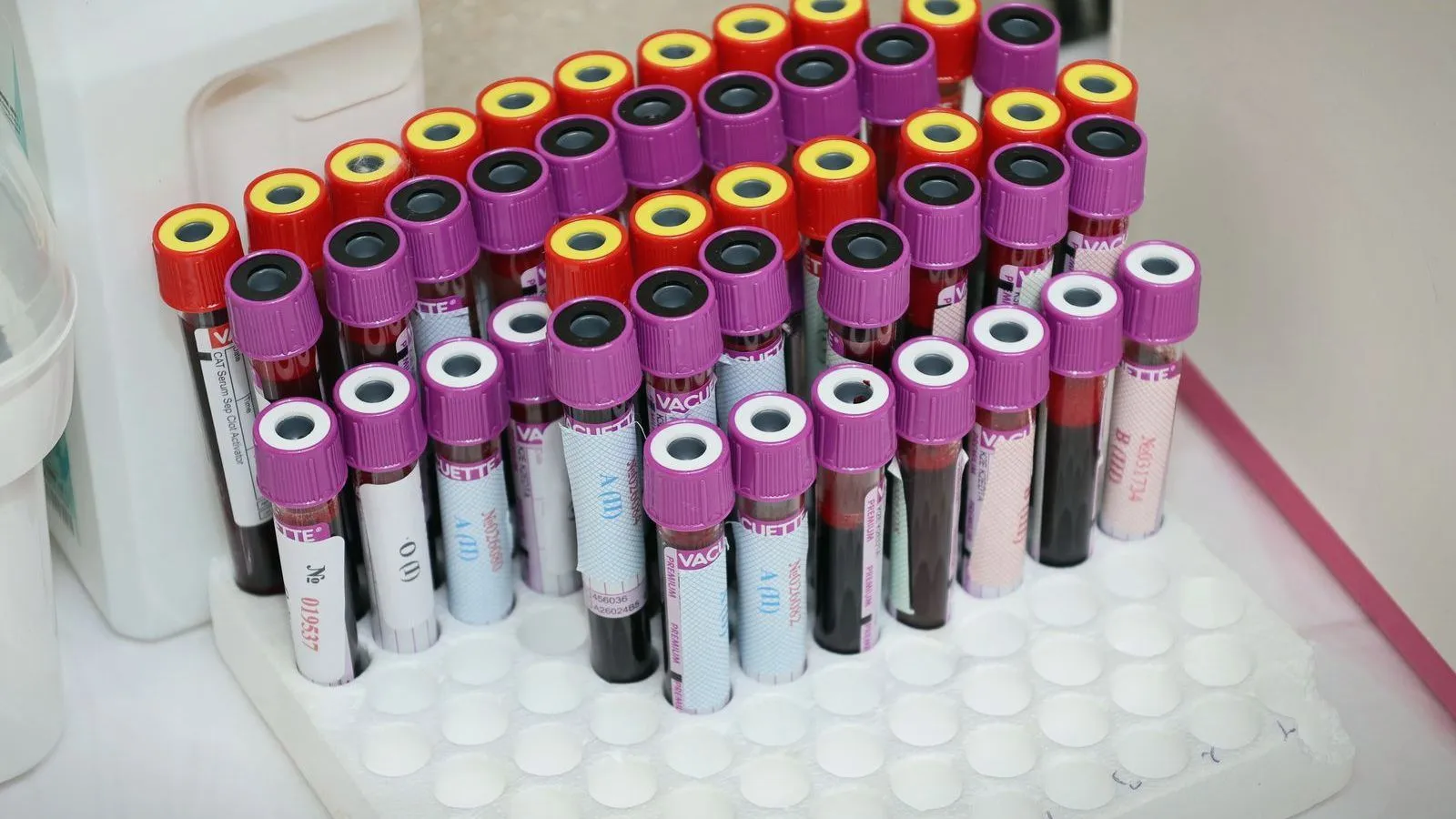
The researchers conducted a cross-cohort assessment of biological age using broad-spectrum LC-MS metabolomics of 3,686 plasma samples in 2,295 participants, aged 20-89. That method, liquid chromatography paired with mass spectrometry, sorts blood molecules by weight and catalogs thousands at once. Two countries, two very different cohorts, one clock.
Two cohorts, deliberately unalike
The samples came from the UK Airwave study, with 960 participants, and TILDA, Ireland’s national aging cohort, with 1,335.
That pairing is the design’s strength. Airwave enrolled British police staff, mostly working-age. The Irish study recruited older adults from the general population. A clock that works in both is less likely to be fitting the quirks of one sample.
The age span ran from 20 to 89, which is wide enough for a clock to learn what aging looks like across a whole adult lifespan, not just what being elderly looks like.
Does it read age at all
First test: can the model recover an age it was not shown?
The team developed a metabolomic clock that was highly predictive of chronological age in held-out test samples, at 0.92 on a scale where 1 would be perfect.
That is high, and it is also the least interesting result. A clock that only recovers the age on your passport tells you nothing you did not already know. The useful signal is in the error.
This is a point the aging-clock field keeps having to restate. Building a model that reads calendar age from blood is a solved problem, and has been for years. Metabolites shift with age in predictable ways, so a large enough dataset will always produce a good fit. The scientific question is whether the people the model gets wrong are wrong in a way that means something.
The gap is the finding
What matters is age acceleration: the distance between what the blood says and what the calendar says.
Two things had to be true for that gap to mean anything. It had to be stable, and it had to predict something.
On stability, metabolomic age acceleration was strongly correlated between study visits, above 0.6 when the same people were sampled again later. So the gap is a property of the person, not of the week they gave blood.
On prediction, the numbers are the reason this paper is worth reading. Each standard deviation increase in metabolomic age acceleration was associated with 43% higher mortality risk, 27% higher risk of mild cognitive impairment, and 10% increased risk of a higher frailty score in fully adjusted models. One standard deviation was roughly five years.
Three different outcomes, in the same direction, after adjustment. That is a more demanding pattern to produce by chance than any single result.
What the molecules were
The clock was not a black box of thousands of tiny contributions. A handful of metabolites carried real weight.
The nucleoside N2,N2-dimethylguanosine, C-glycosyltryptophan, bile acid glucuronides, and the antioxidant zeta-carotene were associated with chronological age, frailty, and mortality. Two more, a noradrenergic breakdown product and the oligosaccharide sialyllactose, tracked both age and death.
Bile acid markers point at liver and gut. Zeta-carotene comes from diet. The noradrenergic metabolite reflects the stress-response system. Whether any of that is mechanism or coincidence is exactly what the authors say remains open.
That short list is worth noting for a practical reason. A clock resting on six identifiable molecules can eventually be measured with a targeted blood test rather than a full research-grade profile, which is the difference between a laboratory finding and something a clinic could one day order. It also makes the biology inspectable. Nobody can interrogate a model built from ten thousand anonymous peaks, but liver function, diet and the stress axis are all things researchers already know how to study.
The limits worth holding onto
This is observational and correlational throughout. The metabolites travel with worse outcomes; nothing here shows they cause them, and nothing shows that pushing a metabolite in the favorable direction would move the outcome. The authors are explicit that these markers should be further investigated in mechanistic studies.
Both cohorts are European. Metabolite profiles shift with diet, and diet shifts with geography, so transfer to other populations remains an open question.
And the framing of the closing claim is careful. The metabolomic clock has potential for translational applications, including as a prognostic and response marker of age-related disease risk. Potential. Not proven, not yet clinical, and worth remembering when a company eventually sells one.
People also ask
What is a metabolomic clock?
A model that estimates biological age from the small molecules circulating in blood, the byproducts of metabolism, rather than from DNA. It is the same idea as an epigenetic clock but a different input. Because metabolites shift with diet, illness, sleep and stress on a timescale of days to months, a metabolite clock is in principle more responsive than a methylation clock, which is one reason the field finds it interesting.
What does age acceleration mean?
The gap between the age the clock estimates and the age on your birth certificate. Positive means the clock reads you as older than you are. In this study, one standard deviation of that gap was about five years, and it was that gap, not the raw estimate, that carried the associations with death, cognition and frailty.
Is 43% higher death risk a big number?
It is substantial for a single blood-based measure, though it needs context. It compares people five years apart on metabolic age within the same study, over the follow-up available, after adjusting for the obvious confounders. It is not a personal forecast and it says nothing about how long any individual will live. Risk ratios describe how groups differ, not what happens to a person.
Does a stable reading across visits matter?
Quite a lot, and it is easy to overlook. A biomarker that swings wildly between measurements is measuring noise as much as signal. Age acceleration here stayed correlated above 0.6 when the same people were sampled again, which suggests the clock is picking up something durable about a person rather than what they ate the day before the blood draw.
Should I get a metabolomic age test?
This is general information, not medical advice, and the honest answer is that the case is not made yet. The authors describe potential translational applications, which is the language of a research finding, not a clinical tool. A separate line of work has found that traditional risk factors can outperform aging clocks at predicting disease. Anyone concerned about their health risk should speak to a clinician, who will start with the cheap measures.