News · Brain & Mental Health
Exergames beat doing nothing for older adults' thinking across 51 trials, on very low certainty
A JMIR network meta-analysis ranked four kinds of digital exercise across 51 randomized trials and 3,673 older adults. Screen-based exergames helped global thinking most consistently. Remote exercise produced the only robust memory gain.
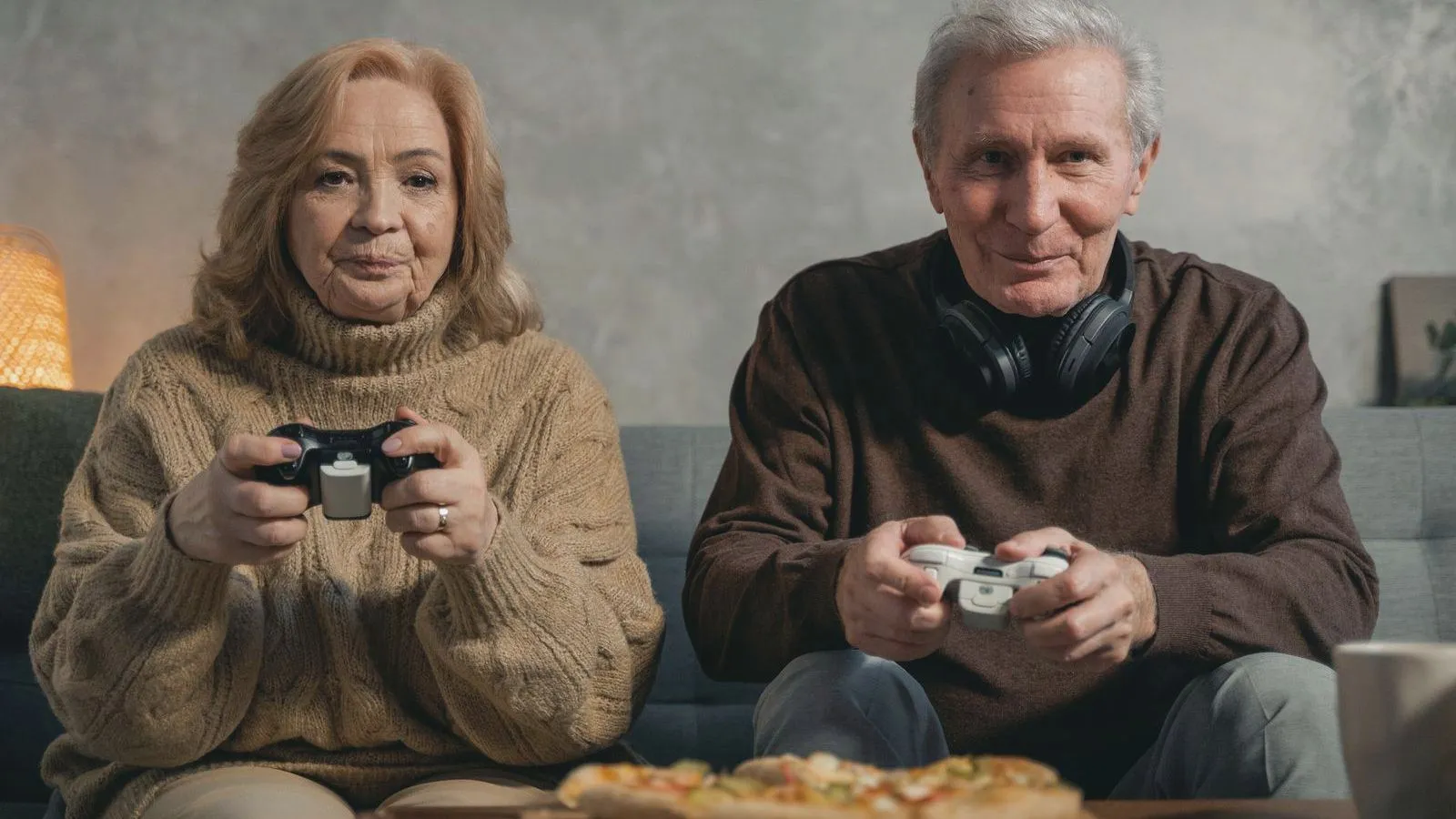
- 51 randomized trials, 3,673 adults aged 60 and over, searched to April 2026.
- Non-immersive exergames beat no intervention for global cognition (SMD 0.51).
- They also beat routine intervention (SMD 0.32), the harder comparison.
- Remote exercise gave the only memory result whose prediction interval excluded the null.
- Certainty was very low for most comparisons, by the authors' own grading.
The cheapest of the four options won, and the most expensive one ranked first without earning it.
Hu and colleagues, writing in the Journal of Medical Internet Research, ranked four kinds of digital exercise for what they do to an older brain: a virtual reality headset, a screen-based exergame of the Wii Fit sort, a real exercise program delivered over video, and virtual reality with cognitive training bolted on. They used a network meta-analysis, the method that ranks treatments never tested head to head by chaining them through a shared comparison. In total, 51 randomized controlled trials with 3,673 participants fed it.
Screen-based exergames came out ahead of both comparisons for global cognition (30 studies), including against ordinary supervised exercise, which is the harder test.
Why beating routine intervention is the real result
Most exercise-and-cognition trials compare doing something against doing nothing, and doing nothing is a low bar. A waiting-list group gets no attention, no schedule and no reason to expect improvement, so almost any structured activity looks good against it.
The exergame result clears both bars. It led against no intervention. The advantage shrank against routine care, but it held. That second, smaller margin is the one worth having, because it is the difference between playing a motion-sensing game and doing ordinary supervised exercise.
For executive function (33 studies), only that same category cleared the bar. Against an active comparison, the advantage disappeared. So the exergame’s edge is broad but shallow: real for general thinking, unproven for the planning-and-switching machinery specifically.
The memory result nobody expected
The strongest single finding in the paper belongs to the least futuristic option.
For memory function, remote exercise was significantly superior to both no intervention and routine intervention, with its prediction interval, the range where a future trial would probably land, also excluding the null. Remote exercise means a coach on a video call telling people to move, which is to say a normal exercise class with the commute removed.
That parenthetical about the prediction interval is the whole point, and it is worth slowing down for. A conventional range says where the average sits across trials already run. A prediction interval says where the next trial would probably land. Almost every other result in this paper has an average that excludes zero and a prediction range that does not, meaning the pooled figure looks clearer than the evidence underneath it. Remote exercise is the exception.
Where the headset ranked and what that is worth
Immersive virtual reality exercise also outperformed no intervention and ranked highest by SUCRA, the surface under the cumulative ranking curve. Read quickly, that is a win for the headset.
That is a ranking probability, and ranking probabilities have a known failure mode: a large effect measured across few small trials outranks a modest effect measured across many good ones. The authors handle this honestly, writing that the headset category “achieved the highest rankings but requires confirmatory trials”.
There is also a result pointing the other way in the same network. Virtual reality exercise combined with cognitive training came out significantly inferior to remote exercise for memory. Adding a cognitive task to the exercise made it worse than a video call, which is an awkward finding for the theory that doing two things at once trains the brain harder.
What very low certainty means for a league table
Certainty was very low for most comparisons, downgraded for unclear allocation concealment, heterogeneity, and suspected reporting bias in executive function.
Unpack that list, because each item is a different problem. Unclear allocation concealment means the trials often did not describe how people were assigned to groups, which is where selection bias enters. Heterogeneity means the trials disagreed with each other. Suspected reporting bias means the pattern of published results looks like the kind produced when unflattering findings stay in a drawer.
None of that makes the direction wrong. All of it means the order of the league table could change with a few good trials, and that the effect sizes are the least trustworthy part.
What an older adult should take from this
The practical reading is more encouraging than the certainty grades suggest, because the intervention that produced the most robust result is also the most ordinary one.
Cumulative training of 1000 minutes or more was associated with more stable memory benefit. Thirty minutes, three times a week, for about ten weeks. That is a target rather than a threshold, and it comes from an exploratory analysis, but it is more concrete than most of this field manages.
None of this is a treatment for memory loss, and the review does not claim otherwise. Older adults may worry about their memory and other thinking abilities, such as taking longer to learn something new, and these changes are usually signs of mild forgetfulness that are often a normal part of aging. What the evidence supports is that moving regularly is good for an aging brain, and that the delivery format matters less than the delivery.
People also ask
What did the analysis find?
NI_ExG significantly outperformed both NI (SMD 0.51, 95% CI 0.26-0.78) and RI (SMD 0.32, 95% CI 0.12-0.53) for global cognition across 30 studies. For memory function across 20 studies, RE was significantly superior to both NI (SMD 1.30, 95% CI 0.15-2.44) and RI (SMD 1.22, 95% CI 0.15-2.28), with its prediction interval also excluding the null.
What are the four kinds of digital exercise?
Immersive virtual reality exercise, meaning a headset; non-immersive exergames, meaning a screen and a motion sensor, the Wii Fit category; remote exercise, meaning a real program delivered over video; and virtual reality exercise combined with cognitive training.
Why does a prediction interval matter more than a confidence interval here?
A confidence interval describes the average effect across the trials already run. A prediction interval describes where the next trial's result would probably land. Several results here have confidence intervals excluding zero and prediction intervals that do not, which means the pooled average is clearer than the underlying evidence.
How certain is the evidence?
Not very. Certainty was very low for most comparisons, downgraded for unclear allocation concealment, heterogeneity, and suspected reporting bias in executive function. The authors say so themselves, and it is the main reason to read the rankings as provisional.
Did the headset win?
It ranked highest and it was not the most reliable. IVR_E also outperformed NI (SMD 0.74, 95% CI 0.11-1.36) and ranked highest by SUCRA, but the authors write that it requires confirmatory trials. Ranking probabilities reward large effects from small evidence bases.
How much is enough?
Cumulative training of 1000 minutes or more was associated with more stable memory benefit. That is roughly 30 minutes three times a week for about two and a half months, and it is one of the few dose signals in this literature.
Should an older adult buy a VR headset for their brain?
Not on this evidence. Older adults may worry about their memory and other thinking abilities, such as taking longer to learn something new, and these changes are usually signs of mild forgetfulness that are often a normal part of aging. Regular exercise is one of the best things you can do for your health regardless of the delivery format. This is general information rather than medical advice.
References
- Hu, Q., Sun, S., Zhu, J., Zhong, X., Dai, S., Jiang, C. Digital Physical Exercise Interventions for Cognitive Functions in Older Adults: Systematic Review and Bayesian Network Meta-Analysis of Randomized Controlled Trials. Journal of Medical Internet Research, 2026.
- National Institute on Aging. Memory Problems, Forgetfulness, and Aging. US National Institutes of Health.
- MedlinePlus. Exercise and Physical Fitness. US National Library of Medicine.