News · Longevity & Aging
One SARS-CoV-2 protein turned lung immune cells into helpers for the virus, in cells and mice
Severe COVID damages the lung far beyond where the virus can easily grow. A study of the ORF8 protein describes how the virus recruits the immune cells sent to contain it.
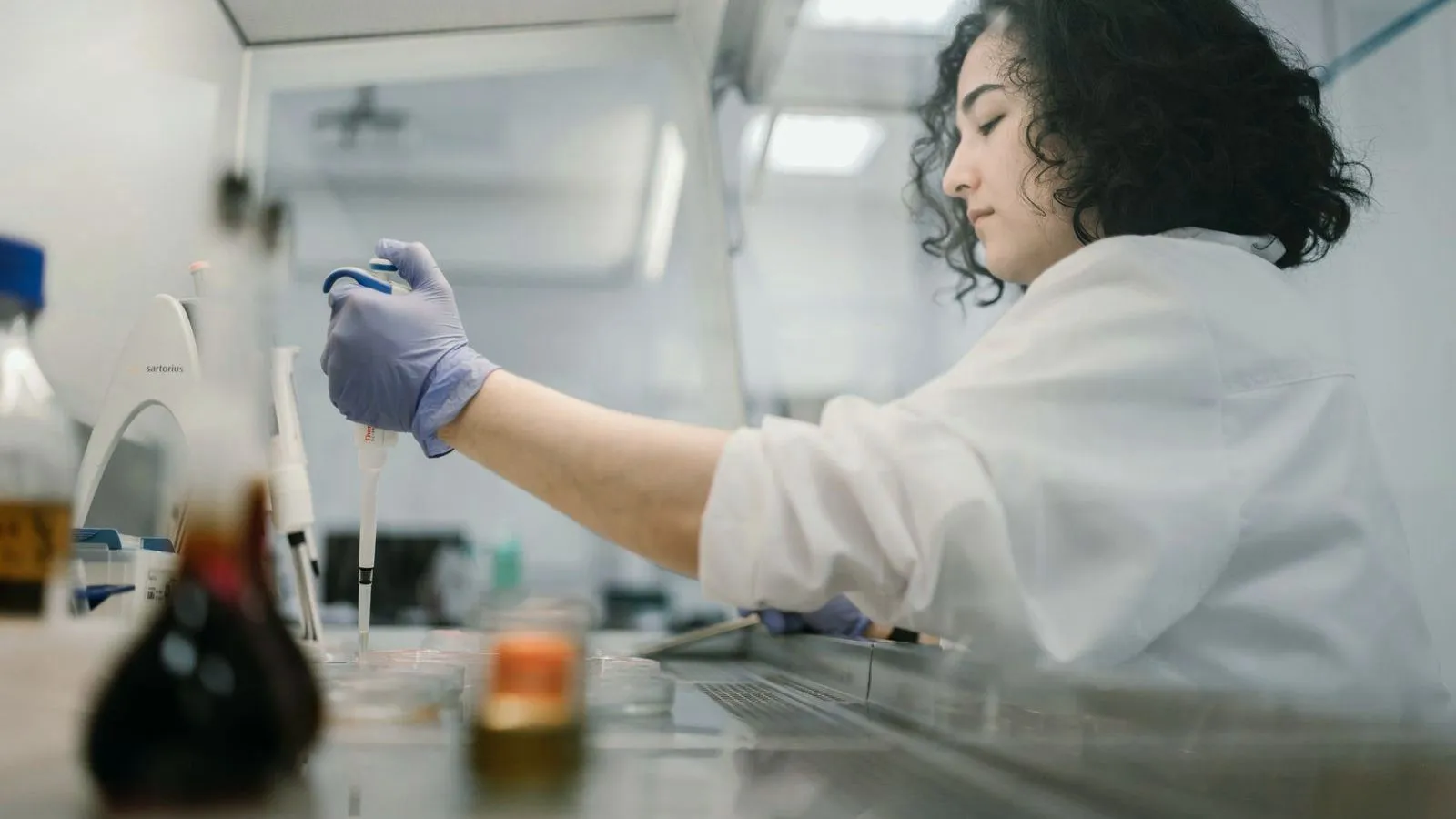
- This is laboratory work in human cells and mice, not a study of patients.
- ORF8 is a small protein the virus makes and releases outside the infected cell.
- It made lung immune cells easier to infect, and they then fed infection of the surrounding tissue.
- Blocking a separate inflammatory signal in mice lowered viral load and reduced lung damage.
- No treatment exists on this evidence, and vaccination remains the measure that has been tested in people.
One of the puzzles of severe COVID has always been the mismatch. The virus needs a particular docking protein to enter a cell, and the deepest parts of the lung carry relatively little of it, yet that is exactly where the worst damage shows up. Something has been amplifying an infection in tissue the virus should struggle to invade.
Work in human cells and mice, published in Science Advances, points at a small protein the virus secretes and at the immune cells sent to deal with it. The virus does not force its way further into the lung. It gets the defenders to carry it.
What is ORF8, and why does a secreted protein matter?
SARS-CoV-2 makes a handful of accessory proteins that are not part of the virus particle. ORF8 is one of them, and its distinguishing feature is that infected cells release it, so it travels to cells the virus has never touched.
That changes what a protein can do. A gene product working only inside its own cell can help that cell make more virus. One released into the tissue can change the behavior of every neighboring cell, including the immune cells arriving to clear the infection. ORF8 has also been a moving target in the pandemic: some variants carry an intact version and others have lost it, which is part of why it draws attention.
How the protein changed lung immune cells
Macrophages are the lung’s resident cleaners, and they are supposed to be a hazard for a virus. The study reports that secreted ORF8 drives inflammatory lung pathology by increasing macrophage permissiveness to infection, triggering pyroptosis, and amplifying viral replication in alveolar epithelial cells.
Permissiveness is the key word. The macrophages became easier to infect, and pyroptosis, the violent rupture that spills inflammatory contents into the tissue, followed.
“We were surprised to see how effectively ORF8 turns our own immune defenses against us,” said Yusuke Matsui, the study’s first author. “ORF8 is hijacking macrophages to enhance infection of the surrounding tissue.”
Why the co-culture experiment is the interesting one
This is where the story gets genuinely odd. ORF8 had been reported before as something that inhibits infection of alveolar cells, which sits awkwardly with a protein that worsens disease. The resolution turns out to be about company.
Co-culture of macrophages with human alveolar type II cells overrides ORF8’s previously reported inhibition of infection, restoring infectious viral production. Alone, the lung cells resisted. With macrophages present, the block disappeared and the virus grew.
That is a useful warning about single-cell-type experiments in general. A protein can look protective in a dish containing one kind of cell and do the opposite in tissue where several kinds talk to each other.
What happened when the inflammatory signal was blocked in mice
The team followed the inflammation to a receptor for interleukin-17, a signaling molecule central to several inflammatory diseases, and blocked it. In mice, that blockade counteracted ORF8 activity, lowering viral burden and attenuating pulmonary inflammation and fibrosis.
Two things are notable there. The intervention reduced the amount of virus as well as the inflammation, which suggests the inflammatory loop was feeding viral growth rather than merely accompanying it. And drugs against this pathway already exist for other conditions, which is why the finding is being described as a target.
“This study answers a fundamental question about how SARS-CoV-2 triggers such overwhelming lung inflammation,” said Melanie Ott, the senior author. Her claim for it is specific: that a single viral protein is the main bridge between viral growth and tissue damage.
What cells and mice cannot settle about severe COVID
The gap between a mouse lung and a human one is the first limit, and for COVID it is a well-documented one. Mice do not naturally catch this virus, so the models are engineered, and results that looked decisive in them have not always survived contact with patients.
Nothing here was tested in a person. No trial has asked whether blocking this pathway helps someone with severe COVID, and dampening an inflammatory receptor during an active infection is exactly the kind of intervention that can cut both ways.
The variant question is also unresolved in a practical sense. If ORF8 matters this much, the virus’s tendency to lose it in some lineages should change how those lineages behave, and that comparison has not been made in people.
Where this leaves the treatment of severe COVID
Nowhere new, today. MedlinePlus keeps the description of the disease itself simple: COVID-19 is an illness caused by a virus, a coronavirus called SARS-CoV-2 that spreads when a person who has the infection breathes out droplets and very small particles that contain the virus. Vaccination remains the measure with evidence in people behind it.
What the work offers is a mechanism with a handle on it. The reason severe COVID has been hard to treat is partly that nobody could say which part of the cascade to interrupt: the virus, the inflammation, or the damage they produce together. A protein that sits at the junction of all three is a better place to aim than any of them separately, and unusually, the drugs that would test the idea already exist.
People also ask
What did the study find?
Secreted ORF8 drives inflammatory lung pathology by increasing macrophage permissiveness to infection, triggering pyroptosis, and amplifying viral replication in alveolar epithelial cells. Co-culturing macrophages with human alveolar type II cells overrode ORF8's previously reported inhibition of infection in those cells, restoring infectious viral production. In mice, blocking the IL-17 receptor counteracted ORF8 activity, lowering viral burden and attenuating pulmonary inflammation and fibrosis.
What is ORF8?
One of the accessory proteins SARS-CoV-2 makes. It is not part of the virus particle itself; infected cells secrete it, so it acts on neighboring cells the virus has not entered. Some variants carry it and some have lost it.
What are macrophages?
Large immune cells that patrol tissue and swallow pathogens and debris. The lung has its own resident population, which is the first thing an inhaled virus meets.
What is pyroptosis?
A violent form of cell death in which the cell ruptures and spills inflammatory signals, rather than shutting down quietly. It is useful against some infections and destructive when it happens at scale.
Could this lead to a treatment?
It identifies a target rather than a treatment. Antibodies against the IL-17 receptor already exist for other conditions, which is why the mouse result is interesting, but nothing here has been tried against COVID in a person.
What should anyone do differently?
Nothing. Vaccination and the usual care for severe illness remain what the evidence in people supports. This is general information rather than medical advice.