News · Brain & Mental Health
PlaySmart video game nudged teen depression scores down a point over a year
Dartmouth researchers gave 532 teenagers either PlaySmart, a game about spotting depression and asking for help, or commercial games. A year on, the PlaySmart group scored a point lower for depression. Anxiety did not move.
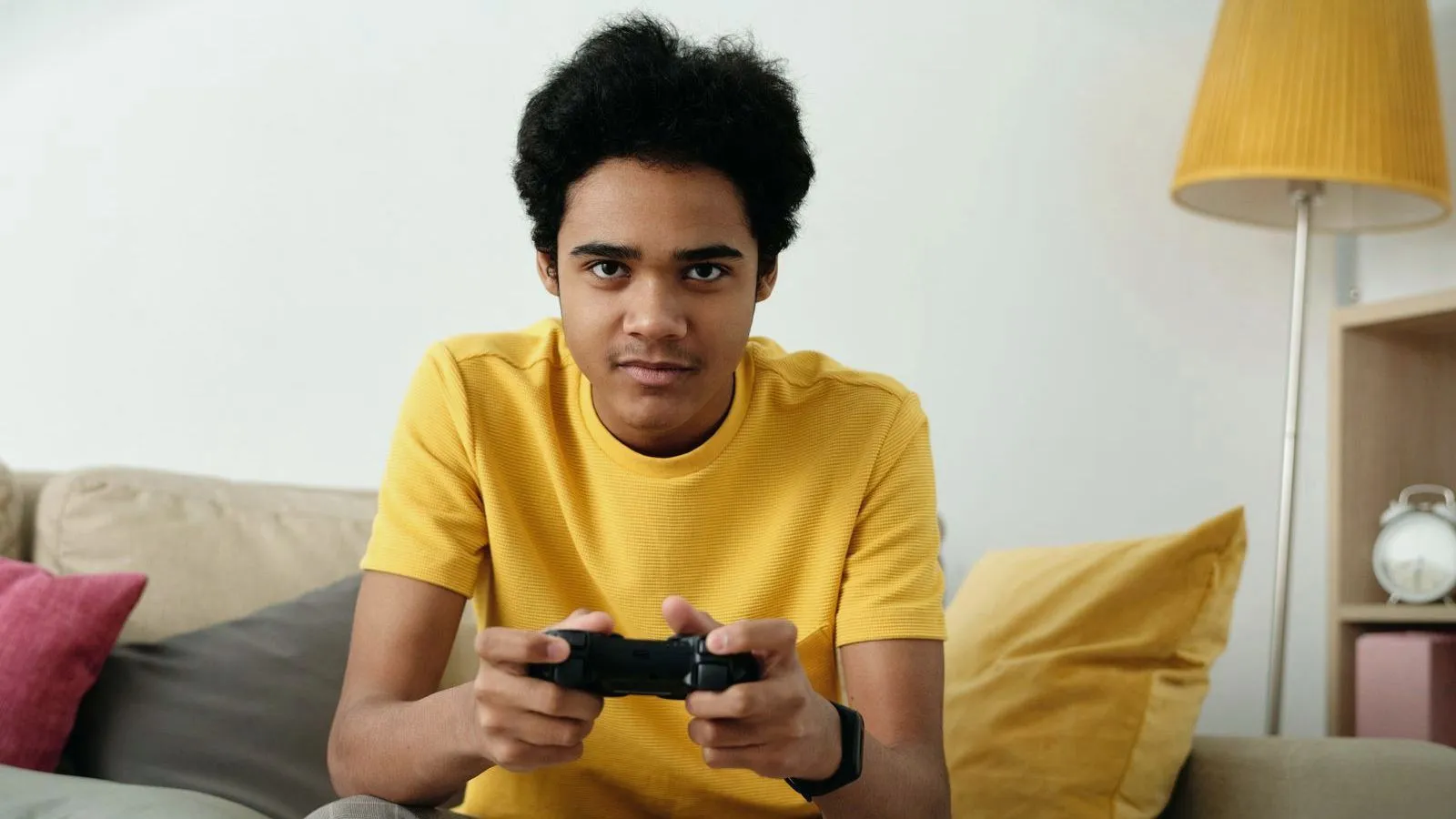
- Depression often begins in the teens, and many teenagers who have it never get care.
- 532 students aged 16 to 19, randomized to PlaySmart or to ordinary commercial games.
- After a year, depression scores sat at 5.30 against 6.42, about one point apart.
- Anxiety scores showed nothing at all. The effect landed on depression only.
- Attitudes to getting help shifted first, which may be how the game does its work.
PlaySmart is a video game that sets teenagers tasks like identifying signs of depression in a friend’s room, then makes them live with whatever they choose.
For six weeks in Connecticut, 269 students played it for about an hour after school once a week while another 263 played ordinary commercial role-playing games with no therapeutic content. Then both groups were left alone for a year.
When the year was up, the PlaySmart players came out lower on depression. At 12 months, adjusted mean scores were 5.30 against 6.42, on a questionnaire that runs from 0 to 24. Barely a point. What makes it worth a second look is that the gap had outlasted eleven months of nobody playing anything.
The teen depression nobody treats
Caroline Barry, the study’s first author, puts the problem at the door of the clinic, before any treatment starts.
“One of the biggest challenges in adolescent mental health is that many young people never receive care because of barriers including stigma, limited access to providers, or just not recognizing they could benefit from help,” she says.
The timing makes it urgent. Depression often begins in the teens or early adulthood, and it is not a mood that passes: depression in teens is a serious medical illness, more than just a feeling of being sad or blue for a few days. It brings an intense feeling of sadness, hopelessness, and anger or frustration that lasts much longer.
Teenagers already using alcohol or cannabis sit at higher risk, since other mental health conditions, including substance use, raise the odds. Those were exactly the teenagers this trial went looking for.
What PlaySmart asks a player to do
The game puts the player inside a story built from things real teenagers described. Behavioral health experts in the play2PREVENT Lab gathered scenarios from teens and other stakeholders while developing it, documenting healthy and unhealthy decisions and the blind spots in what teens knew. Play involves choices with consequences. Tasks include identifying signs of depression in a friend’s room, or deciding to turn to a trusted adult for help with a difficult situation. Better choices lead to more positive outcomes for the player and other characters, while bad choices lead to more negative outcomes.
Players can then rewind. The game lets them work backward to analyze their decision-making and explore what might have happened had they made different choices, which is a mechanic no leaflet and no assembly talk can offer.
Why the control group matters more than the game
Most digital mental health trials compare an app against a waiting list, and a waiting list loses to almost anything. The team, reporting in the American Medical Association journal, JAMA Network Open, did not take that route.
Participants were randomized 1:1 to a digital game of approximately 300 minutes delivered during 6 weeks or to an attention-matched active control. The control group got games too, just commercial ones with no therapeutic content.
Lynn Fiellin, the senior author and a professor of biomedical data science and medicine at Dartmouth’s Geisel School of Medicine, puts the weight on that design.
“Serious games for prevention and mental health promotion are a rapidly growing area, but the evidence base is still emerging,” she says. “Few clinical trials in this space combine a randomized design with commercial games as an active control and a 12-month follow-up. The rigorous design of our study alone sets a high bar for demonstrating impact.”
She is right, and it cuts both ways. Testing against real games strips out the novelty, the screen time and the attention, so whatever survives is closer to the content itself. It also guarantees a smaller number at the end, because the comparison group was not doing nothing.
PlaySmart’s one point, held for a year
Here are the numbers the trial produced. At 12 months, adjusted mean depression scores were 5.30 in the intervention group and 6.42 in the control group, an adjusted difference of about 1.12 points.
Both groups landed in the mild band of that questionnaire. Nobody was cured; a cohort with some symptoms still had some symptoms. What travels is the persistence. Six weeks of gameplay, then eleven months of nothing, and the gap was still measurable. The authors describe the effect as modest and sustained reductions in depressive symptoms during 12 months of follow-up, and both halves of that phrase are doing honest work.
Anxiety, meanwhile, went nowhere: no association detected for the seven-question anxiety scale. That is half the stated target missed, and the authors say so as plainly as this.
The best clue about how the game works
Buried under the headline is a hint about mechanism. At 6 weeks, the PlaySmart players reported higher scores on a measure of beliefs about psychological services: they thought better of the idea of getting help. And exploratory mediation showed that early improvements in those beliefs were associated with depression score reductions at 6 months.
Read that as a chain and it says something unexpected. The game may not be treating anybody’s depression. It may be changing their mind about asking someone else to.
That would fit Barry’s framing of the problem, and it would fit the content, which spends its time on noticing symptoms and telling a trusted adult rather than on therapy technique. It would also explain the flat anxiety result, since nothing in the game goes near anxiety. The paper labels the analysis exploratory, which makes it a lead worth chasing and not yet a mechanism.
What the PlaySmart trial leaves open
This prespecified secondary analysis of a randomized clinical trial named depression and anxiety as outcomes before anyone looked at the data. That is a real distinction from the fishing that “secondary analysis” often implies, and it still is not the question the trial was designed around.
Everything rests on self-report. Teenagers filled in questionnaires about their own symptoms and their own attitudes, and no clinician assessed anybody. The teenagers were also specific: 16 to 19, drawn from 15 school-based health programs in one state, recruited because they were already using substances or already had symptoms. Around 45% were Black and 38% were Hispanic, groups the release notes report among the nation’s highest rates of sadness and hopelessness, so this is evidence about a population most digital health trials leave out, and not about teenagers in general.
Barry argues the consistency is the point: “The benefit held across all subgroups, which matters for an intervention meant to be delivered schoolwide or in communities broadly.”
Where a one-point gain in depression actually counts
The authors never call this a treatment. Their conclusion stops at a sentence worth reading twice: “digital games may support adolescent mental health at scale”. All the weight sits on the last two words.
One point is a poor showing for a therapy. For something that costs almost nothing per extra player, needs no clinician and reaches the teenagers Barry describes as never receiving care, it is a different sum altogether, because the alternative is not a better game but a counselor who does not exist. Connecticut cannot hire its way to 269 more of those, and it can copy a game for nothing.
A parent has less to work with here than the headline suggests. PlaySmart is a lab’s research tool and not something you can buy, and a teenager in trouble needs a person rather than a download. The route to getting teen depression treated still runs through a doctor or a school health program, and nothing in this trial moves it.
What the trial leaves behind is the lead about belief. If part of what keeps a teenager away from help is what they think of help, and six weeks of a game can shift that, then the cheapest thing worth building may be whatever gets them through the door. That analysis was exploratory. One trial, one hypothesis, and no more than that.
People also ask
What did the trial find?
At 12 months, adjusted mean PHQ-8 scores were 5.30 (95% CI, 4.74-5.86) in the intervention group and 6.42 (95% CI, 5.86-6.98) in the control group (adjusted difference, -1.12 [95% CI, -1.85 to -0.38] points), with no association detected for GAD-7. PHQ-8 is an 8-item depression questionnaire scored 0 to 24; GAD-7 is a 7-item anxiety questionnaire.
Is a 1.12-point difference a lot?
No. Both groups finished in the mild range of the scale, roughly a point apart, and the authors call the reductions modest. What is unusual is that the gap was still there a year after six weeks of gameplay, and that it held against an active control rather than against nothing.
What was the comparison group doing?
Playing. Participants were randomized 1:1 to a digital game of approximately 300 minutes delivered during 6 weeks or to an attention-matched active control, which in practice meant commercial role-playing games with no therapeutic content. That is a far harder test than a waiting list, because both groups got screen time, novelty and attention.
Who was in it?
Among 532 participants, 269 were randomized to the intervention and 263 to the control condition; 284 (53.4%) were male, with a mean age of 16.6 years. They came from 15 school-based health programs in Connecticut and were eligible if they reported past 30-day use of alcohol, cannabis, vaping, or other nonopioid substances, or elevated depression and/or anxiety symptoms.
Why did anxiety not shift?
The paper does not say. The game's content centers on recognizing depression and on deciding to tell someone, so one reading is that it taught a depression-specific skill. That is an interpretation rather than a finding.
How might the game be working?
Through attitudes, on the paper's own exploratory reading. At 6 weeks, intervention participants reported higher scores on a measure of beliefs about psychological services, and exploratory mediation showed that early improvements in those beliefs were associated with PHQ-8 score reductions at 6 months. Exploratory means this was a look rather than a test.
Should a parent buy their teenager this game?
PlaySmart is a research tool from an academic lab, not a product on a shelf, and one trial of a modest effect is not a treatment recommendation. Depression in teens is a serious medical illness, and it is more than just a feeling of being sad or blue for a few days. If a teenager is struggling, the route is a doctor or a school health program. This is general information rather than medical advice.
References
- Barry, C. M., Boomer, T., Haile, K., Xie, H., Fiellin, L. E. A Digital Behavioral Health Game for Adolescent Mental Health: A Prespecified Secondary Analysis of a Randomized Clinical Trial. JAMA Network Open, 2026.
- Dartmouth. Video Games Built for Prevention Can Reduce Teen Depression.
- MedlinePlus. Teen Depression. US National Library of Medicine.